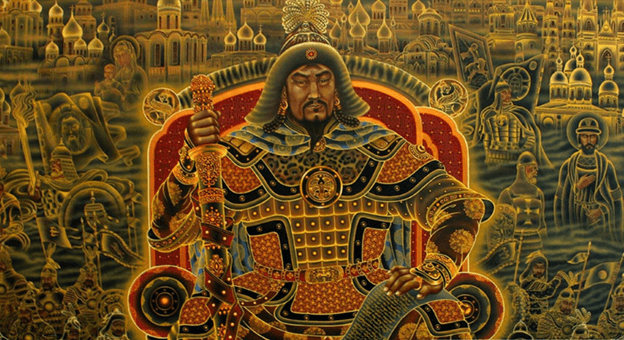

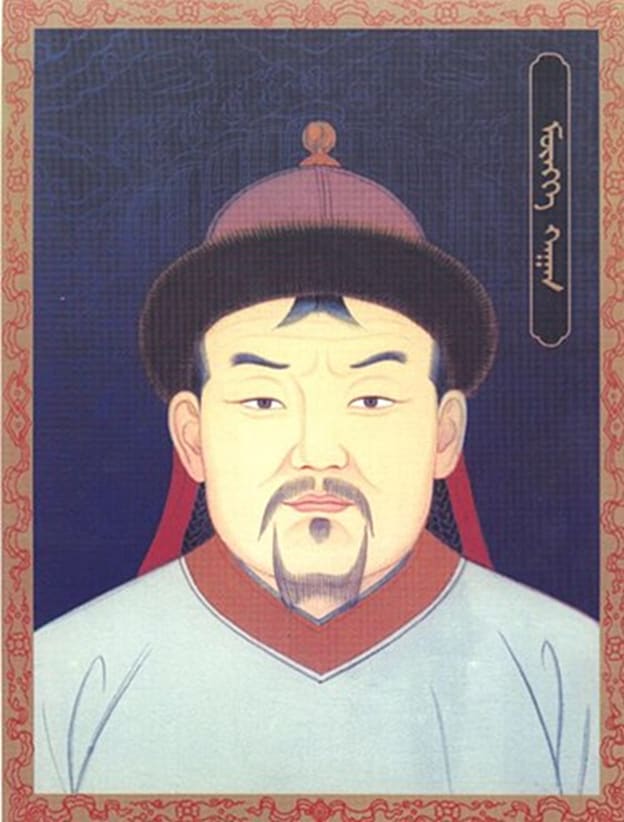
Batu was born in 1209 and was the second son of Jochi, the eldest son of Chinggis Khan. According to Rashid al-Din, Jochi had about forty sons. Batu’s mother, Uqi-fujin, came from the Khongirat tribe and was the daughter of Ilchi-noyan.
In 1224, Chinggis Khan divided his empire into four parts and apportioned the uluses among his sons. Jochi received all the steppe lands west of the Irtysh—both those already within the Mongol Empire and those still to be conquered. After Jochi’s death in 1227, his ulus passed to his elder sons Orda-Ejen and Batu. Although Orda-Ejen, as the elder, formally had the right to the “throne,” he ceded it to his brother: he received the Irtysh region, while Batu was assigned the western, as yet unconquered, territories.
After Chinggis Khan’s death in 1227, a new Great Khan, Ögedei, was elected at the quriltai in 1229. Eighteen-year-old Batu took part in this assembly but, after it ended, did not return to his ulus and remained at court. By the will of the new khan, part of the lands of the Ulus of Jochi went to Ögedei (in Siberia), and part to Chagatai (in Central Asia). From 1230 to 1234 Batu, together with Ögedei, took part in the war against the Jin Empire, and at the 1235 quriltai the Jochids were granted the district of Pingyang-fu (in modern Shanxi), the revenues of which flowed into their treasury.
At the same quriltai it was proclaimed that a “western campaign” would begin with the goal of subduing all lands lying to the west. Batu was named the official leader of this campaign.
In the winter of 1236 the Mongols subdued Volga Bulgaria; in the summer and autumn of 1236, Mordovia. In 1237–1238, under the Mongol onslaught, almost all of Northeastern Rus’ fell. In 1239 the Black Sea steppe and Crimea were conquered; these would later be incorporated into the Ulus of Jochi. In 1240–1241, Southwestern Rus’ fell as well—thus all Rus’ submitted to the Mongols.
In 1241–1242 Batu moved into Poland and Hungary. He led the invasion of Hungary, directed the assaults on Pest and Esztergom, and devised the plan for the Battle of the Sajó River, where King Béla IV suffered a crushing defeat. Mongol forces traversed Hungary, Croatia, Dalmatia, Bosnia, Serbia, and Bulgaria. When the Mongol vanguard reached Vienna, news reached Batu of the death of Khan Ögedei; under the laws of Chinggis Khan, all Chinggisids were obliged to appear for the election of a new Great Khan. Batu had to turn his army around and return to the steppe—thus ended the Mongols’ “western campaign.”

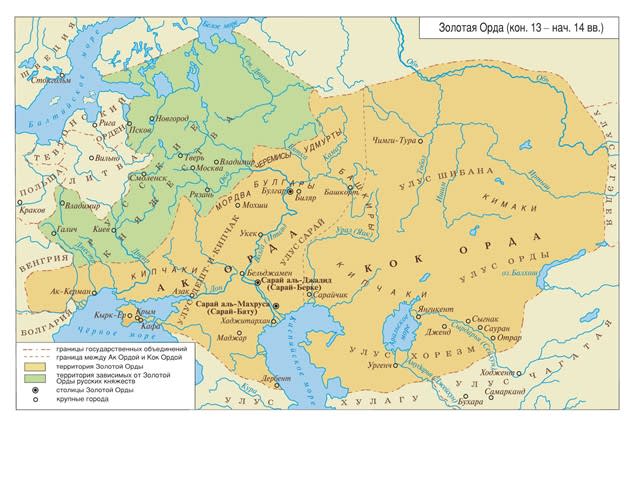
Directly incorporated into the Ulus of Jochi were the western Dasht-i Qipchaq (Kipchak Steppe), Volga Bulgaria, Crimea, the territory of modern Bashkiria, and part of the North Caucasus. The Rus’ principalities, Bulgaria, Wallachia, Serbia, and certain regions of Hungary acknowledged vassal dependence on the Ulus of Jochi. On Batu’s initiative, following steppe tradition, rule within the ulus was divided into two autonomous “wings,” the Kökh Orda (Blue Horde) and the Aq Orda (White Horde); the boundary was the Yaik (Ural) River. The fixed center of the western wing was the city of Bulgar; Batu himself settled in the Volga region. Orda-Ejen’s headquarters, at the head of the eastern wing, lay between the Tarbagatai and the upper Irtysh.
In the winter of 1242–1243 Batu demanded the personal appearance of the three chief Rus’ princes—Yaroslav Vsevolodovich (Grand Prince of Vladimir), Daniil Romanovich (of Volhynia and Galicia), and Mikhail Vsevolodovich (of Chernigov)—each of whom had recently held Kyiv. The question to be settled was recognition of dependence and the confirmation of “seniority” among the princes.
Daniil and Mikhail evaded the summons, while Yaroslav came to Batu in 1243 and received “seniority.” Since in 1243 Güyük had not yet been confirmed as Ögedei’s successor, it was Konstantin, Yaroslav’s son, who went to Karakorum; Batu sent Yaroslav to the Great Khan’s court in 1246, when Güyük’s enthronement had become a foregone conclusion.
Daniil Romanovich appeared at Batu’s camp in the autumn of 1245 after the Mongol commander Möuci demanded the surrender of Halych. Batu reproached him with the words: “Danilo, why did you not come long ago?” Daniil’s domains, including the Halych land, were confirmed for him.
Mikhail Vsevolodovich arrived in the summer of 1246, asking for “his district” (Chernigov), but refusing to bow to the “idol of Chinggis Khan,” he was executed on Batu’s orders; according to John of Plano Carpini, the refusal served merely as a pretext.
In 1245–1246, others also came to Batu for yarliks (charters): Konstantin Vsevolodovich of Yaroslavl, Boris Vasilkovich of Rostov, Gleb Vasilkovich of Belozero, Sviatoslav Vsevolodovich of Suzdal, and Ivan Vsevolodovich of Starodub. In 1254 the Armenian king Hetoum visited Batu.
In 1242 Queen Rusudan of Georgia, at Batu’s demand, sent him her son David, who acknowledged Mongol suzerainty. In 1243, Kaykhusraw II, sultan of the Rum (Seljuk) Sultanate, after being defeated at Köse Dağ by the forces of Noyan Baiju, recognized himself as Batu’s vassal; Batu issued the sultan a yarlik and a paiza. In the 1240s–1250s Batu was de facto the suzerain of Rum; however, his successors in the Golden Horde did not control Anatolia, which passed under Hülegü’s authority.
Ögedei had named his grandson Shiremun as successor; the guardian of the Yasa, Chagatai, was ready to carry out this will but died the same year. After his death the aka (senior) of the lineage became Batu. Rival claimants to the great-khanship included Shiremun (by testament), Güyük (backed by Töregene Khatun), Batu (as aka, head of the Jochids, and in fact the strongest ruler), Möngke (backed by his mother Sorghaghtani Beki), and Temüge-Otchigin (Chinggis Khan’s younger brother). In 1242 Shiremun and Temüge-Otchigin dropped out of the struggle; Batu and Möngke united against Güyük.
At the 1246 quriltai Güyük was elected. Despite their long enmity, Batu acknowledged his election through intermediaries and was formally designated a co-ruler of the new Great Khan. At first Güyük did not interfere in the internal affairs of the Ulus of Jochi, but soon he began to curb Batu’s power by appointing dual rulers in states that had received yarliks from Batu. Güyük set out on campaign against Batu but, in 1248, while in Māwarannahr near Samarkand, died unexpectedly (by one account—poisoned by Batu’s supporters). Among his opponents was Batu’s loyal ally Möngke, a participant in the western campaign; with Batu’s help he was elected Great Khan in 1251. To support Möngke against the Chagataid heirs, Batu sent his brother Berke with a hundred-thousand-strong corps under the tümen-chief Burundai to Otrar.
Batu died no earlier than 1255. His lawful heir was his son Sartaq, who was at Möngke Khan’s court; however, on the way home Sartaq died unexpectedly, and the khanship was proclaimed for the minor Ulaghchi, Sartaq’s son and Batu’s grandson, who also died soon after. Thereafter Batu’s brother Berke became the new khan.


