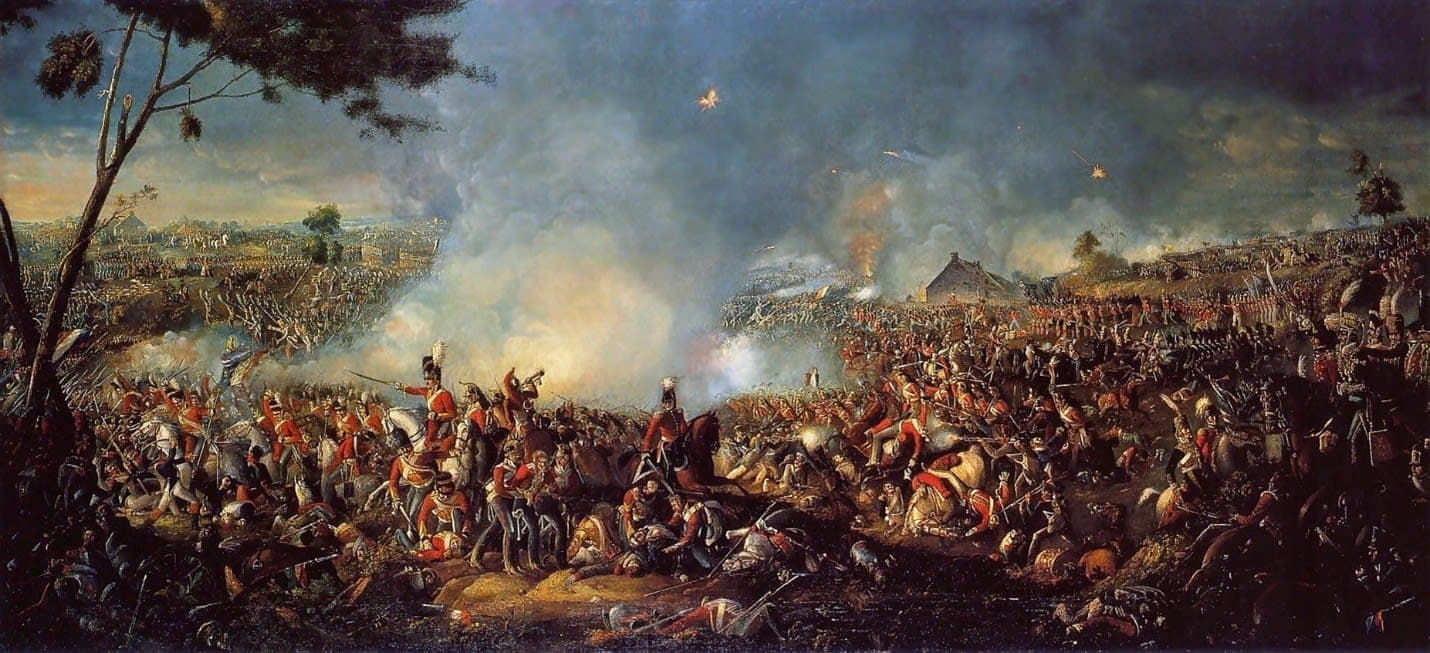
On March 13, 1815, even before Napoleon managed to enter Paris after his triumphant return from the island of Elba, the allied powers declared him an outlaw. A few days later, mass mobilization of the coalition armies began; by June 10 they already numbered 700,000 men and planned to reach a million. Napoleon, however, at that moment had only 198,000 soldiers, of whom only 128,000 could take part in the campaign. In this desperate situation, the French emperor had only one chance of success to defeat the allies in parts before they could unite their forces.


On June 14 Napoleon moved into Belgium. His plan was to strike swiftly at the army of the Prussian Field Marshal Blücher. However, his actions were somewhat complicated by the treason of General Bourmont, who fled to the Prussians, revealing Napoleon’s plans. On June 15 Napoleon sent Marshal Ney to hold back Wellington’s army at Quatre Bras, while he himself on June 16 attacked Blücher at Ligny.
In the Battle of Ligny Napoleon defeated the Prussian army, but due to the delay of the 1st French corps it was not completely destroyed and was able to retreat. On the same day the Battle of Quatre Bras took place, which ended in a tactical draw.


On June 17 Napoleon entrusted an army of 35,000 men to Marshal Grouchy with orders to pursue the retreating Blücher, whose direction of withdrawal was unknown. Napoleon himself, with the main forces, moved north toward Brussels, without warning Grouchy about this. Meanwhile, Wellington’s army occupied a favorable position on the heights of Mont-Saint-Jean, 22 kilometers from Brussels. Having received Blücher’s promise to join him the next day, Wellington decided to accept battle right there.

At the start of the battle the allied forces numbered about 70,000 men with 159 guns, while the French had 72,500 men with 250 guns. The battle that determined Napoleon’s fate began on June 18 and lasted from 11:35 a.m. to 8 p.m.
The battle began with an attack by the French army on the farm of Hougoumont and the woods surrounding it. Initially this attack was planned as a diversion to force Wellington to transfer reserves from the center. However, it grew into an independent, fierce battle in which both sides suffered enormous losses. Historians still cannot agree on the exact time it began.
The farm of Hougoumont and the adjacent woods were defended by elite British Guardsmen, as well as Hanoverian jägers and Nassauers. Napoleon sent against Hougoumont Reille’s corps, consisting of the divisions of Jérôme Bonaparte, Foy, and Bachelu. The French stormed the farm all day. The brigades of Bauduin and Soye managed to take the woods and the park, but were driven out by British reserves. Lieutenant Legros, with a small group of soldiers, even managed to break into the courtyard, but they were all killed. The defenders of Hougoumont, including units of the British Guards and the King’s German Legion, held firm, repelling numerous attacks.

Both Wellington and Napoleon attached enormous importance to this position. Hougoumont was not just a farm, but a key point, control over which could allow the French to reach the rear of the British positions. Napoleon, watching the battle through a spyglass, constantly transferred more and more reserves there. In total, during the day 14 thousand Frenchmen and 12 thousand Britons fought here. The French infantry never managed to break the defense of the elite British units sheltered behind the stone walls of the manor, which withstood several artillery bombardments.
The time the French infantry attack on the center of the allied forces began is also a matter of debate, but most sources indicate 1:30 p.m. By that moment Napoleon already knew of the approach of the Prussian army of Bülow, which gave him no more than two or three hours to defeat Wellington. He sent against Bülow Lobau’s 6th Corps and still considered his chances of victory high.
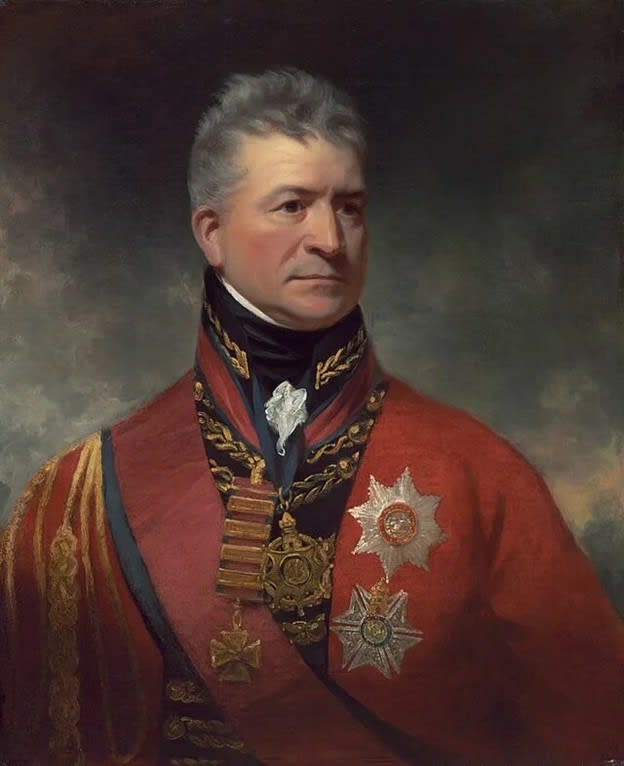
After a powerful artillery bombardment, the effect of which was weakened by the ground soaked after rain, 16,000 French infantrymen went on the attack. Their formation was too dense, which subsequently hampered maneuvering. The attack was directed at Wellington’s left flank. The French managed to rout the Dutch division of Van Bijlandt, but on the ridge, they encountered Thomas Picton’s detachment. The British infantry held on by their last strength; Picton was killed, and his units began gradually to retreat.

At the critical moment, when the British infantry was on the verge of defeat, the Earl of Uxbridge threw into the fight two brigades of heavy cavalry those of Edward Somerset and William Ponsonby. They boldly attacked the French infantry and cuirassiers. Ponsonby’s brigade overthrew the infantry, capturing 3,000 prisoners and two regimental eagles. However, carried away by the pursuit, the cavalrymen rushed toward the French positions and attacked the batteries.
This proved their fatal mistake. The organized withdrawal turned into a disorderly flight. French lancers, counterattacking the exhausted British cavalrymen, inflicted heavy losses on them. Major General Ponsonby was killed. The British heavy cavalry, having lost its formation, suffered enormous losses, which, however, were never calculated precisely. Despite this, the counterattack of the allies’ light cavalry forced the French to retreat to their starting positions. Twenty thousand men took part in this attack, and the French lost not only 3,000 prisoners but also precious time. The Prussian army was already close.
Shortly before 4 p.m., Marshal Ney noticed movement in the center of Wellington’s army, which he mistakenly took for a retreat. Lacking infantry reserves, he decided to attack the enemy center with cavalry alone. This attack was an incredible mistake, since cavalry was rarely used without infantry support against battle formations.
For the attack, Milhaud’s cuirassier corps and Lefebvre-Desnouettes’s light cavalry division were employed, and then Kellermann’s corps and Guyot’s division joined them. The total number of horsemen reached 9,000 sabers. Napoleon later blamed now Ney, now Milhaud for this mistake.
Meanwhile, Wellington’s soldiers quickly formed into squares dense formations that were almost impregnable to cavalry. The French cuirassiers advanced at a slow trot and were met by artillery fire. They burst into the British positions but could not break the squares. The cavalrymen captured the guns but had no opportunity to destroy them. Suffering serious losses from musket fire, they were forced to retreat.
Ney, not giving up, reformed the cavalry and led it into a new attack. By this time the first shots of Prussian artillery were heard—the arrival of Bülow’s corps. The cavalry attacks continued, and in one of them as many as 9,000 horsemen took part. They were met by Mercer’s Scottish battery, which, ignoring orders, remained with its guns. His gunners repelled the attack, and ultimately the French cavalry, having suffered enormous losses, was forced to withdraw. Ney lost a third of his soldiers and horses.
By 6 p.m. the cavalry attacks were over. Despite enormous losses, the French managed to capture 4 or 6 enemy colors. At the same time Napoleon, knowing of the Prussians’ appearance, ordered Ney to storm the farm of La Haye Sainte, which was located in the center of Wellington’s positions. Due to oversight, the defenders of the farm had almost no ammunition left, and the French, breaking inside, killed almost the entire garrison. Thus, Wellington lost a key position.
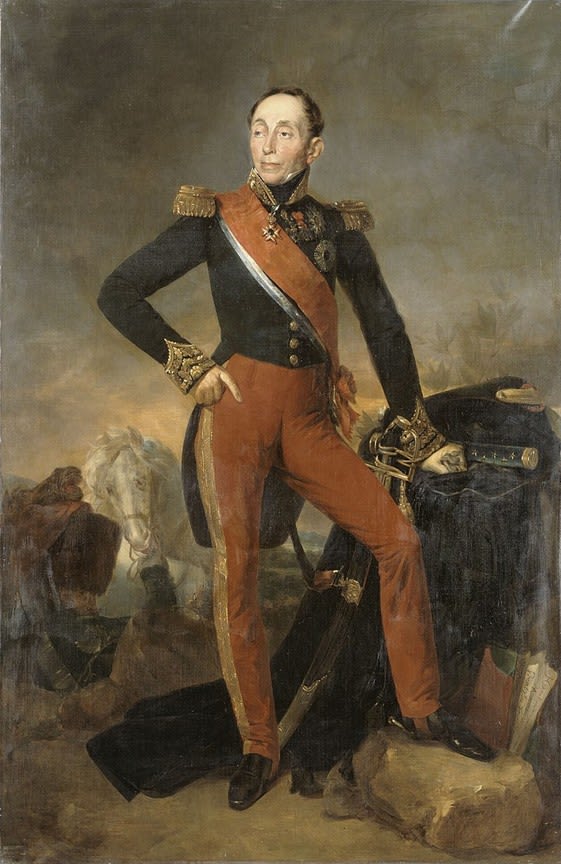
While the battle raged in the center, the fate of the engagement was being decided on the flanks. At 11 a.m. the Prussian Field Marshal Blücher moved from Wavre along difficult roads toward Waterloo, fulfilling his promise to Wellington. Marshal Grouchy, whom Napoleon had tasked with pursuing Blücher, was at that time in Wavre. At 11:30 he heard the first shots, but mistakenly decided that it was Wellington’s rearguards firing. Despite his generals’ proposals to “march to the guns” (toward the sound of firing), Grouchy did not deviate from his orders and continued the advance on Wavre, unaware of Napoleon’s real intentions.

By noon the vanguard of Bülow’s Prussian corps was already at Chapelle-Saint-Lambert, only six kilometers from Plancenoit. Around 1:30 p.m. Blücher personally led the advance across the marshy valley toward Plancenoit. At 4 p.m. Grouchy received a letter from Napoleon ordering him to move to unite, but by that time he was already engaged in battle at Wavre with Thielemann’s corps. Blücher, learning of this, merely waved his hand: “Let General Thielemann defend himself as best he can. His defeat at Wavre will not matter if we win here.”
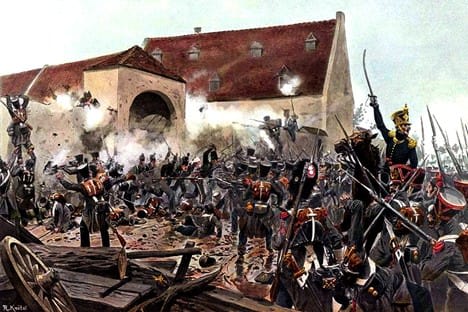
At this time Bülow’s leading elements approached the Bois de Paris. A Prussian battery opened fire on the French to signal its presence. Ten thousand infantrymen of the French General Lobau attacked the Prussian brigades and at first pushed them back, but with the arrival of the remaining units Bülow received 30,000 men in reinforcement. Lobau was forced to retreat. One of the Prussian roundshot fell near Napoleon. The French emperor immediately sent fresh forces, including the Young Guard, to retake the village of Plancenoit. These forces forced Bülow to fall back temporarily.
After Wellington lost the farm of La Haye Sainte in the center, and the situation at Plancenoit was temporarily stabilized, Napoleon committed his last and most powerful reserve the Imperial Guard. This attack, undertaken around 7:30 p.m., was to break Wellington’s center, drive back his army, and prevent it from joining with the Prussians. In the attack, in all likelihood, five battalions of the Middle Guard took part.

Three battalions of the Old Guard formed the second line, remaining in reserve. Napoleon personally addressed the Guardsmen, saying, “All follow me!”, and led them into the attack up to La Haye Sainte. The five battalions moved in echelon and were met by a hail of canister and bullets. The volleys of British artillery, loaded with double case shot, annihilated entire squadrons. Marshal Ney’s fifth horse was killed.
Passing through this hellish fire, about 3,000 Guardsmen split into three columns. The first column, the grenadiers, attacked the Brunswick battalions. The British brigade of Colin Halkett was also pushed back, and its commander was gravely wounded. The Dutch division under Lieutenant General David Chassé opened case-shot fire into the grenadiers’ flank and then attacked with bayonets. Only this attack managed to stop the French Guard.

A little further west, two battalions of the 3rd regiment of chasseurs encountered 1,500 British Guardsmen of Peregrine Maitland, who, lying low, suddenly rose and fired a volley at close range. The chasseurs were stunned; more than 300 of them died in the first seconds. Soon the remnants of the French columns, seeing the fate of their comrades, began to retreat.
When the Guard began to fall back, a wave of panic swept through the ranks of the French army. Cries were heard: “The Guard is running!”, “We have been betrayed!”, “Save yourselves, whoever can!” Wellington, seeing this, stood in the stirrups and with a wave of his hat gave the signal for a general attack. His exhausted soldiers, despite fatigue and difficult terrain, moved forward. The arriving units of Zieten helped pursue the French.
The last desperate fight took place near the village of Plancenoit, where the Prussian soldiers continued their advance. The French troops were pushed back, and the British Guards offered stubborn resistance to Napoleon’s retreating Guardsmen. In the end this point too was taken.
Napoleon, seeing the complete rout, tried to break through to his Guard to die with it, but was almost forcibly carried from the battlefield by staff officers. The remnants of the Guard, surrounded by superior enemy forces, refused to surrender and were swept away by canister.
The allied commanders-in-chief, Wellington and Blücher, met at the farm of La Belle Alliance and decided to entrust further pursuit to the Prussians. The pursuit was carried out with incredible energy for three days, and the French army was finally demoralized. Napoleon managed to assemble no more than 3,000 men, which deprived him of any possibility of defending the capital and continuing the war.
The Battle of Waterloo was a complete defeat for Napoleon. The French lost from 25,000 to 27,000 killed and wounded, 6,000–8,000 prisoners, as well as 240 guns. The allies also suffered serious losses: Wellington’s army lost about 17,000 men, and Blücher’s Prussian army about 7,000 men. In total, 15,750 people were killed on the battlefield.


This battle became the end of Napoleon’s Hundred Days and concluded the era of the Napoleonic Wars. The successful junction of the armies of Wellington and Blücher, as well as errors in Napoleon’s command, led to the final collapse of his empire and to his further exile to the island of Saint Helena.


