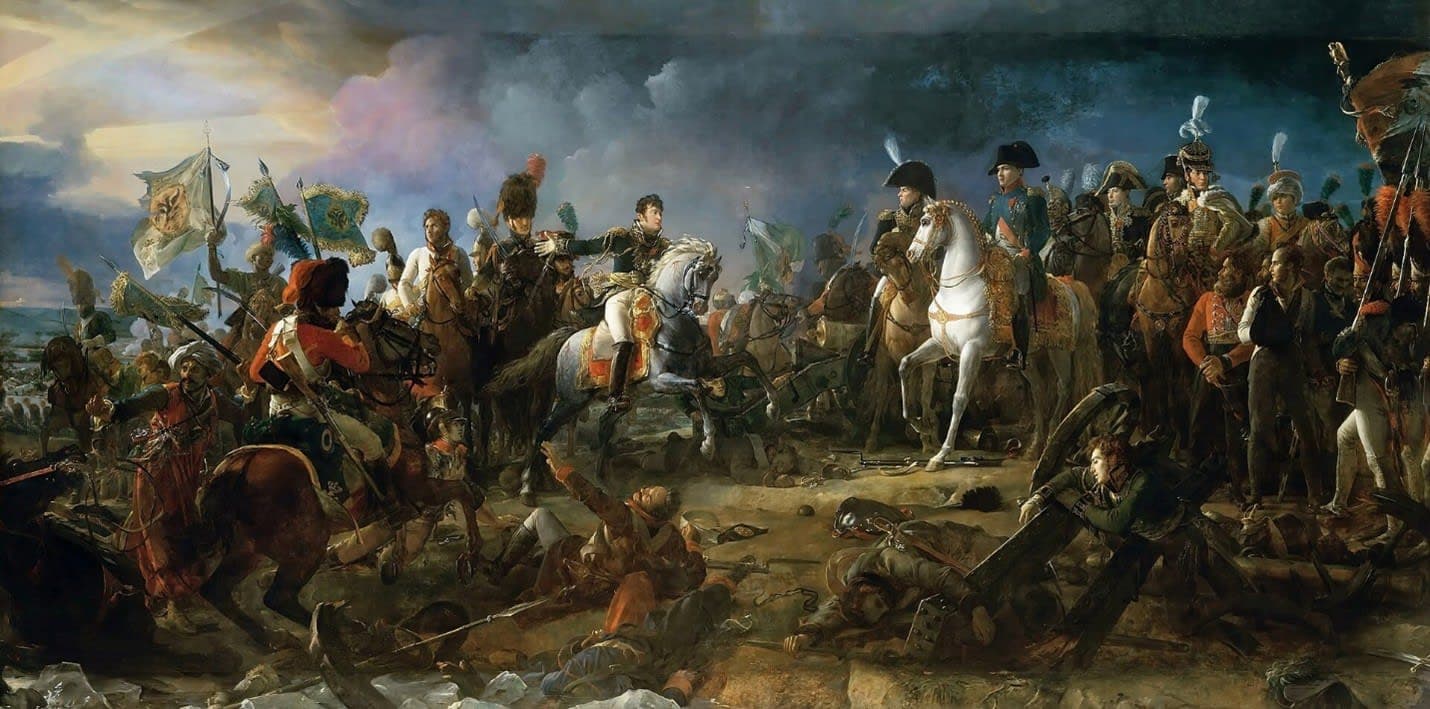

By the end of 1805, two great armies had converged in a decisive confrontation on European soil. The allied forces, consisting of a 60-thousand Russian army and a 25-thousand Austrian army, numbered a total of about 85 thousand men with 278 guns. Overall command nominally belonged to General M. I. Kutuzov, however actual control was in the hands of the two emperors — Alexander I and Francis II. The French army under the command of Napoleon Bonaparte was smaller in number and totaled 73.5 thousand men. Napoleon deliberately did not display superiority in strength, fearing to scare off the enemy, and was confident that his forces would be sufficient for victory.

On the night of December 2, 1805, the allied forces formed up in battle order. The left wing, commanded by General F. F. Buxhoeveden, consisted of three Russian columns under the leadership of Generals D. S. Dokhturov, A. F. Langeron, and I. Ya. Przhibyshevsky. The center of the army, directly subordinate to Kutuzov, was represented by the Russo-Austrian column of Generals I. K. Kolowrat and M. A. Miloradovich. The right wing, consisting of the Russian column of General P. I. Bagration consisting of 13 thousand men and the Austrian cavalry of Johann Liechtenstein of 4,600 men, was under the overall command of Bagration. The Guard reserve under the command of Grand Duke Konstantin Pavlovich of 3,500 men was positioned behind the 4th column.

The battle plan proposed by the Austrian General Weyrother was risky and did not take into account possible enemy actions. Weyrother, who underestimated Napoleon’s generalship and considered the French army much smaller (40–50 thousand men), proposed an outflanking movement by the left wing. Kutuzov, well informed about the real numbers of the French, did not agree with this plan, but could not influence the decision of Emperor Alexander I.
Napoleon knew about the disagreements in the allied command and anticipated their tactics. He understood that the Austrians would strive to cut his army off from the road to Vienna and the Danube, and to do this would undertake a wide outflanking movement by the left wing. This would inevitably lead to the stretching of the allied army’s front, which became the basis for Napoleon’s cunning plan. He deliberately concentrated his forces in the center, creating for the enemy the false impression that his army could be easily encircled. In reality he was preparing a swift and crushing blow to the weakened center of the allies.
The advance of the French troops on the key Pratzen Heights began in the ninth hour of the morning. By that moment the left wing of the allies, which had begun its flanking movement before dawn, had already moved sufficiently far from the center. The small Russian center was immediately attacked by the main forces of the French army, numbering over 50 thousand men, and was forced to retreat.
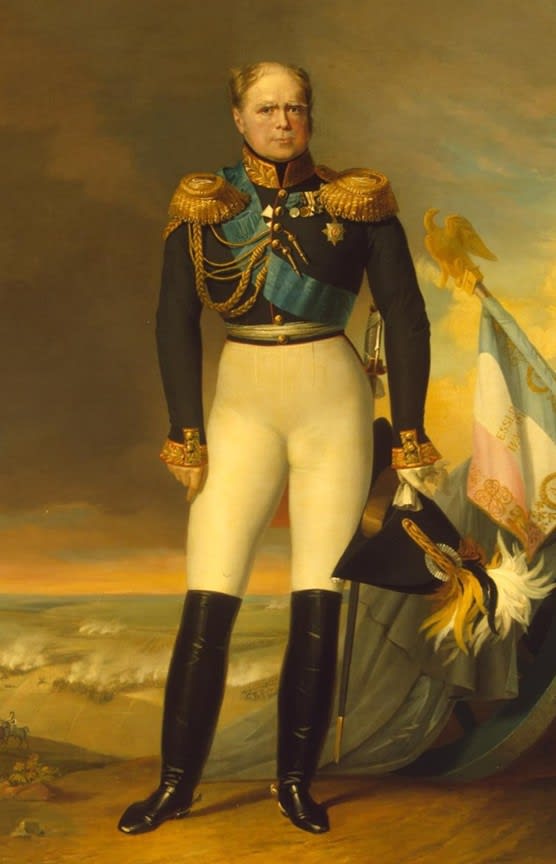
Meanwhile Grand Duke Konstantin Pavlovich, leading the Guard reserve, moved toward Blazovice and ended up in the battle line rather than in reserve, as prescribed by the disposition. The Austrian cavalry of Liechtenstein, located on the right flank, attacked the French cavalry but was routed. The Russian Uhlan Tsarevich’s Regiment, without waiting for reinforcements, rushed into a desperate but unsuccessful attack, breaking through three lines of French cavalry and infantry. Disordered and having suffered heavy losses (28 officers and 480 other ranks), the uhlans were forced to withdraw.
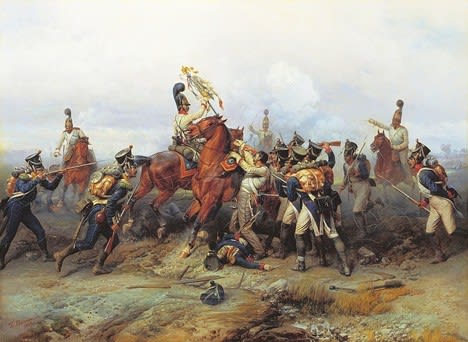
Konstantin Pavlovich’s attempts to break through to the Pratzen Heights were met by French attacks, which were successfully repelled by the Guards: the Preobrazhenskys and Semenovskys showed courage, and the Life Guards Horse Regiment especially distinguished itself, which, attacking Vandamme’s infantry, captured the eagle of the 4th Line Regiment. However, exhausted and disorganized, they could not withstand the furious onslaught of Napoleon’s Mamelukes under Rapp’s command. Seeing that a breakthrough was impossible, Konstantin Pavlovich ordered a retreat.

After the capture of the Pratzen Heights Napoleon brought the full might of his army down on the left wing of the allies, which found itself enveloped from front and rear. Only then did the commander of the left wing, Buxhoeveden, realizing the scale of the catastrophe, begin to retreat. Part of his troops was driven back toward the frozen ponds. In his victory bulletin Napoleon exaggerated the number of those drowned to 20 thousand, although later studies by French historians showed that from 800 to 1,000 people died in the ponds.
The right wing of the allies under Bagration’s command offered stubborn resistance but was forced to retreat after Murat’s cavalry was thrown against it. Emperors Alexander I and Francis II left the battlefield long before its end. The wounded Kutuzov barely avoided capture.
The Battle of Austerlitz ended in the complete rout of the allied army. Their total losses amounted to up to 35 thousand men. According to various estimates, from 11 to 20 thousand were taken prisoner. French losses were significantly smaller about 9–9.5 thousand men killed, wounded, and captured. The French also captured 160 Russian and 37 Austrian guns.
The defeat had serious political consequences; the Austrian Emperor Francis declared the futility of continuing the struggle, which led to Austria’s exit from the war and the collapse of the Third anti-French coalition. Russia continued the war as part of the Fourth Coalition.
Despite the heavy defeat, which became the first for the Russian army since the time of Peter the Great, it did not break the fighting spirit of the Russian soldiers and the people. A significant part of the troops managed to retreat in an organized manner and formed the basis of the army that continued the fighting. Unlike many other great battles, Austerlitz did not lead to the complete destruction of the enemy’s main forces, which historians often note, comparing it, for example, with the Battles of Cannae or Waterloo.
Nevertheless, Austerlitz is an outstanding example of the military art, where a complete victory was achieved by one simple but brilliant maneuver carried out at a perfectly chosen moment. This battle became a classic example of the transition from defense to counterstrike. In the words of the military historian Hans Delbrück, “Austerlitz may serve as a modern repetition” of the great Battle of Marathon.


