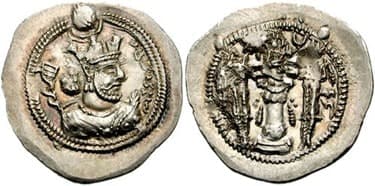

After the catastrophic death of Peroz in the war with the Hephthalites, a struggle for the throne began between his sons, Hormizd III and Balash. According to one version, before his last campaign Peroz appointed Balash regent, which allowed him to ascend the throne easily. However, according to other sources, he had to fight his brother Zareh (Zarir). Balash, supported by the Armenian cavalry under Vahan Mamikonian, won, and Zareh was seized and strangled in Ctesiphon.

Balash was a peaceable and meek man, and this character trait, in the opinion of historians, did not allow him to become a strong and independent ruler. He came to power at a time when the country was devastated, the treasury empty, and the people suffering from the consequences of the war with the Hephthalites. The lack of funds to maintain the army made him dependent on the powerful nobility, which in fact took power into its own hands. The most influential figures were representatives of the noble houses of Karen and Mihran, Sukhra (Sohr) and his son Zarmihr. It was they who took the initiative in restoring the state.

The most important achievement of Balash’s reign was the conclusion of peace with the Hephthalites. The official Sasanian tradition, reflected in the Shahnameh, states that the commander Sukhra defeated the king of the Hephthalites, forcing him to return captured treasures and prisoners, including Peroz’s son Kavad. However, other, more reliable, sources testify that peace was bought at the price of a heavy indemnity, which Persia continued to pay for several years.
Balash also tried to obtain tribute from Byzantium, but Emperor Zeno refused him, referring to the fact that the Persians were already receiving revenues from the city of Nisibin, which had not been returned to the Romans despite the expiration of the treaty term.

Despite these failures, there is information that Balash waged a successful war with a certain Indian ruler. He is said to have defeated him in single combat, routed his army, and captured the capital. This episode is probably based on real events and testifies that on the southeastern borders the Sasanians still held their positions.
Balash, being a protégé of the nobility, strove for peace and stability. One of his main achievements was the conclusion of the Treaty of Nvarsak in 484. This treaty put an end to the bloody uprising in the Transcaucasus which raged in the last years of Peroz’s reign. Under its terms, the Armenians received the right to freely profess Christianity, the Zoroastrian temples were destroyed, and the Armenian nobility restored their hereditary rights. The ruler of Armenia became the shah himself, and not his deputies, and Vahan Mamikonian was confirmed in the office of marzpan (governor).
Balash also cared about the welfare of the people. He punished landowners who ruined peasants with excessive levies, and actively engaged in the restoration of cities that had fallen into decline. Al-Tabari writes that Balash “zealously sought the prosperity of the country” and brought to account those who drove their subjects into poverty.

However, Balash’s peaceable policy did not save him from downfall. He had frictions with the Zoroastrian priesthood which, rumor had it, hated him for his neglect of Zoroastrian laws. The dissatisfaction of the nobility also grew, since he could not provide the army with a sufficient amount of gold.
In the end, Balash was overthrown. According to one version, he was deposed by the magi, his eyes were put out, and Kavad was raised to the throne. According to another, described in the Shahnameh, the chief commander Sufray himself deposed him, declaring that Balash was incapable of ruling. Balash could say nothing in reply and withdrew, and Sufray brought Kavad to power.
Balash’s reign was very short only four years, but it became an important transitional period in the history of the Sasanians. As a meek and peaceable ruler, he brought peace and stability to a devastated country, managed to normalize relations with Byzantium and the peoples of the Transcaucasus, but his dependence on the nobility and his weakness before the priesthood predetermined his downfall.


