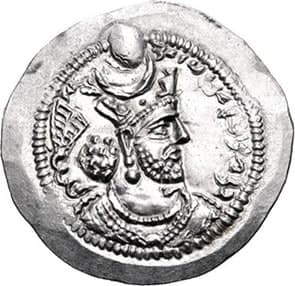

Bahram V, nicknamed Gur (“onager”), was the second son of Yazdegerd I. His youth was unusual for a Sasanian prince: he was brought up at the court of the Arab petty kings of Hira, first with Nu‘man I and then with Mundhir I. This was not only an honorable exile, but also an excellent school of life. There the future shah received a brilliant education for that time, mastering horseback riding, hunting, and the military arts. He attained such mastery in hunting wild asses that he earned his famous nickname Gur.
After the death of his father, Yazdegerd I, turmoil broke out in Persia. The nobility, dissatisfied with the cruel policy of the late shah, did not wish to see any of his sons on the throne. They raised to the throne a representative of a collateral line of the dynasty, Khosrow. Bahram’s elder brother, Shapur, who ruled in Armenia, hastened to the capital to assert his rights, but was killed by the nobility.

Learning of this, Bahram, with an army of Arabs headed by Nu‘man, marched on Ctesiphon. However, upon arriving in the capital, he did not enter into a bloody struggle. Instead, according to Ferdowsi, it was decided to convene a council for new elections. The nobility did not want to elect Bahram because of his origins and the memory of his father’s cruelty. Then Bahram proposed to resolve the dispute in a truly royal manner: the crown was placed between two ferocious lions, and the contenders were to take it. Khosrow, being already advanced in years, refused, and Bahram killed both lions with his mace, took the crown, and became shah.
Eastern sources specify that this event took place in April 421. Ascending the throne, Bahram showed his good will, forgiving the people all tax arrears and richly rewarding his rival Khosrow.
The reign of Bahram V proved unexpected for the nobility. The brave prince who had seized the throne by force turned out not to be inclined to affairs of state. He gave himself over to entertainments, banquets, and above all hunting, for which he became a legendary figure in Persian folklore. In fact, all power fell into the hands of the great landed aristocracy, headed by Mihr-Narseh, the grand vizier since the time of Yazdegerd I.
This new political course led to persecutions of Christians, who had previously enjoyed the favor of Yazdegerd I. This was a natural result of the strengthening power of the Zoroastrian clergy and the nobility, who did not forgive the Christians their former influence. The persecutions, begun at the will of the “unclean magi and pagan grandees,” lasted about five years. In response, the Iranian Christians convened a council in 424, at which they declared the complete separation of their church from Byzantium.
These events, as well as Byzantium’s refusal to extradite fugitive Christians, became the pretext for war between Iran and Byzantium, which began in the summer of 421. The war unfolded to Persia’s disadvantage. Mihr-Narseh’s troops suffered defeat, and the campaign of the Lakhmid Arabs, allies of Bahram, ended in failure. In 422 Byzantium was forced to conclude peace because of a Hunnic invasion. As a result, neither power received any territorial gains, but they confirmed their joint obligations for the defense of the borders. Byzantium also obtained permission for the Christians of Iran to freely profess their faith.
Under Bahram V Iran faced a serious threat on its eastern frontiers from the nomadic tribes of the Chionites, Kidarites, and Hephthalites. These peoples invaded the territory of Iran.
Bahram, leaving his brother Narseh in Ctesiphon, set out on a campaign to the east. He reached the environs of Merv, where he defeated the enemies with a sudden night strike. Eastern sources differ in details, but agree on one thing: Bahram pursued the enemy to the Amu Darya, establishing this river as the new border. In honor of this victory, he remitted taxes for three years and, according to tradition, erected a tower to mark the end of Iran’s domains. He also sent envoys to bring neighboring tribes into submission and possibly founded a stronghold at Merverrud for further advance eastward.


Like his father, Bahram V died under mysterious circumstances. According to one legend, while hunting he fell with his horse into a deep pit. But modern historians believe that most likely he was killed by courtiers. His reign lasted about 20 years and ended in late 440.
Bahram V became one of the most popular heroes of Eastern folklore and literature. Many legends and tales were composed about him, in which he appears now as an ideal king-hero, now as a frivolous rake. The main versions of his story are contained in Ferdowsi’s Shahnameh and Nizami’s Seven Beauties. Legends about his hunting exploits, especially the tragic story with the concubine Azadeh, became favorite subjects for artists, especially on Sasanian silver dishes.
The image of Bahram Gur, the hunter of onagers, entered forever into the history of Iranian culture, becoming a symbol of courage, nobility, and love of adventure.


