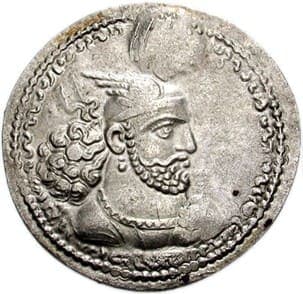

Before the death of his father, Bahram II, the future Sasanian shah, ruled the province of Sakastan. When his father died, he is said to have grieved so deeply that for forty days he did not accept power, plunging into mourning. However, in the opinion of historians, the true reason for the delay may have been different. Bahram II had an uncle, Narseh, who considered himself the legitimate heir to the throne, since he was older than his nephew.

At this time a fierce struggle for power unfolded at court. The principal supporter of the young Bahram II was Kartir, the fanatical and power-hungry high priest of Zoroastrianism. Fearing he would lose his influence if the throne were occupied by the mature and independent Narseh, Kartir and his supporters among the clergy and nobility gave Bahram II every possible support. It was thanks to their efforts that Bahram II secured the throne. Narseh remained to rule Armenia.
Interested in the support of the nobility, the new shah made significant concessions. The Arab historian al-Mas‘udi wrote that under Bahram II many lands were transferred to the shahanshah’s intimates with the right of tax immunity, which led to the impoverishment of the treasury and the growth of “the poverty of the people and the army.”
The reign of Bahram II was marked by an unprecedented strengthening of the power of the high priest Kartir. This was a unique case in the history of Sasanian Iran: Kartir, like kings, ordered his own inscriptions to be carved on rocks. Having received the title “Guardian of Bahram’s soul,” he completely subordinated the young shah to himself.
In his inscriptions, for example on the “Kaaba of Zoroaster,” Kartir openly declared his actions. He actively converted non-believers to Zoroastrianism, mercilessly fought followers of other religions, increased the welfare of the priests, and built new fire temples. In the inscription he boasts that “the Mazdayasnian faith and the Magi in the land received great dominion,” and that “unbelief… the Jews, and the Buddhist priests, and the Brahmins, and the Nazarenes, and the Christians and the Mandaeans and the zindiks (Manichaeans) in the land were smashed, and (their) idols smashed.”


Under Bahram II, Mani’s successor, the prophet Sisinnius, was executed. However, despite Kartir’s statements about persecutions, Christian sources of that time do not mention them, and Bahram II himself, according to some reports, was even interested in Christian teaching and knew the Syriac language.
Neither Ferdowsi nor the Arab historians give details about the reign of Bahram II, so historians reconstruct his history from the coins, inscriptions, and reliefs of that period. Official propaganda acquired enormous significance in this period. Bahram II became the only Sasanian king to mint on coins the portraits of his wife, Queen Shapurdukhtak, and the heir to the throne. On the crowns of his relatives were depicted the heads of mythical and real animals symbolizing Zoroastrian deities.
Over 17 years of his reign Bahram II created about twenty types of coins and a full ten rock reliefs more than any other Sasanian ruler. These reliefs, located in different parts of the country, served as a means of official propaganda.
At Barm-e Delak one relief shows the king giving an iris to his wife, which is a rare example of a love scene in Sasanian art. Another relief shows Bahram II and his vizier making a gesture of respect, which points to their close relations.
At Sarab-e Qandil the queen gives a lotus flower to her husband, and their son, the future Bahram III, holds the ring of power.
A relief at Naqsh-e Rustam shows an audience with Bahram II, where he sits alongside his forebears Bahram I, Shapur I, and Ardashir I. His pose, with his hand on a gigantic sword, emphasizes his strength and determination.
At Sar Mashhad a relief depicts Bahram II fighting lions, protecting his family.
At Gayum a relief shows the king standing with raised hand in an unfinished investiture scene, which may symbolize his divine favor.
These monuments show that Bahram II, despite his youth, strove to strengthen his position by using art as an instrument for legitimizing his power.


In 283 the Roman emperor Carus undertook a campaign into Mesopotamia. The sources differ in details, but it is known that he reached Ctesiphon. However, the sudden death of Carus (either from illness or from a lightning strike) halted the advance. After this event formal relations of “brotherhood” were established between Rome and Iran, and the rulers of the two powers began to address each other as “brother” in official letters. This fact indicates that Rome was forced to recognize the equality of the Sasanian Empire.
However, during the Roman campaign Persia was occupied with internal rebellions. In the early 280s one of Shapur I’s grandsons, the king of Meshan, rose up. This revolt was suppressed. A second, larger rebellion was led by Bahram II’s cousin named Hormizd, who with the assistance of the Kushans attempted to create his own kingdom in Khorasan. He even struck coins, calling himself “king of kings.” Bahram II succeeded in suppressing this uprising as well, and he ordered his victory to be perpetuated on a relief at Naqsh-e Rustam. After this he appointed his son Bahram III shah of Sakastan.

The rebellion in the east probably served as the reason that in 288 Bahram II sent gifts to the new Roman emperor Diocletian, concluding with him a kind of agreement. As a result, Diocletian restored Tiridates III, who had fled to the Romans, to the Armenian throne, while Narseh continued to rule most of Armenia.
The reign of Bahram II lasted 17 years, according to most sources, and left a deep mark on the history of Iran, especially in its religious and political life.


