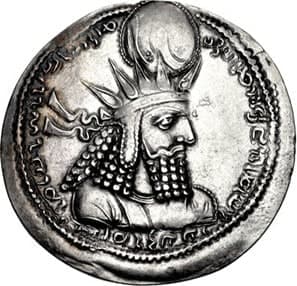

Bahram I (also known as Varahran I) was the son of the Sasanian shah Shapur I. Already during his father’s lifetime he displayed his administrative and military talents. First, he ruled the province of Gilan, and then, after the year 260, he received another appanage Kerman. In the sources he is described as a man who valued the art of war, hunting, and banquets, considering these pursuits virtuous. At the same time, he was also characterized as “a noble and good man,” and his accession to the throne was greeted by the people with joy. He “treated them well and, as a king, followed the path of his fathers.”
This image of a noble ruler is reflected in the investiture relief at Bishapur, where Bahram I is depicted receiving the ring of power from the hand of the god Ormazd. This relief, with its majestic figures and finely balanced composition, is considered one of the most beautiful examples of Sasanian rock art.


The reign of Bahram I was short but eventful. Soon after his accession, the Romans under the energetic emperor Aurelian went to war against the Persians. The reason was that the Sasanian Empire supported Zenobia, queen of Palmyra, who had proclaimed independence from Rome and had become an ally of Iran. While civil wars raged in the Roman Empire, Zenobia successfully opposed Rome, but Aurelian, having stabilized the situation, moved east.

He defeated the Persian detachments hastening to Palmyra’s aid and took the city. Zenobia tried to flee to Iran on camels, but was intercepted by Roman cavalry. Aurelian, who had moved against the Persians, was killed by his intimates in 275, and the Roman legions withdrew. Thus, at the beginning of Bahram I’s reign, peace was established on the western borders of his empire, which lasted for several years.

The most significant event of Bahram I’s reign was the execution of the prophet Mani, the founder of Manichaeism. By this act Bahram departed from the policy of religious toleration pursued by his father Shapur I and his brother Hormizd I. He took the side of the powerful high priest of Zoroastrianism, Kartir, who was a fanatical adherent of his religion.
Mani, sensing that the attitude toward his teaching had changed, decided to leave Iran and head for the lands of the Kushans. Bahram, however, forbade him to do so. In January 276 Mani was summoned to court. The shah met him with threats, accusing him of undermining the foundations of the state and of refusing to participate in public life. He demanded that Mani confirm his faith by a miracle, proposing to him a trial by molten lead. Mani refused. Bahram ordered him arrested and shackled. Soon the prophet died of exhaustion in prison. His body, like that of a criminal, was beheaded.
There is also another version of his death, transmitted by the church historian Socrates Scholasticus. According to this legend, Mani was unable to heal the king’s sick son, and the boy died in his arms. In reprisal Bahram ordered Mani’s skin to be flayed, stuffed with straw, and set up at the city gate.

The reign of Bahram I was short. According to the extracts of Sergius cited by Agathias of Myrina, he ruled for 3 years. In other sources one can find more complex numerical combinations, for example “3 years and 3 months” or “3 years, 3 months, and 3 days,” but they are likely later embellishments of legendary accounts.
Despite its short duration, the reign of Bahram I became an important milestone in the history of the Sasanian Empire. He changed the religious course, abandoning the toleration of his predecessors and laying the groundwork for a harsher policy toward other beliefs, which subsequently led to the strengthening of Zoroastrianism as the state religion of the Sasanians.


