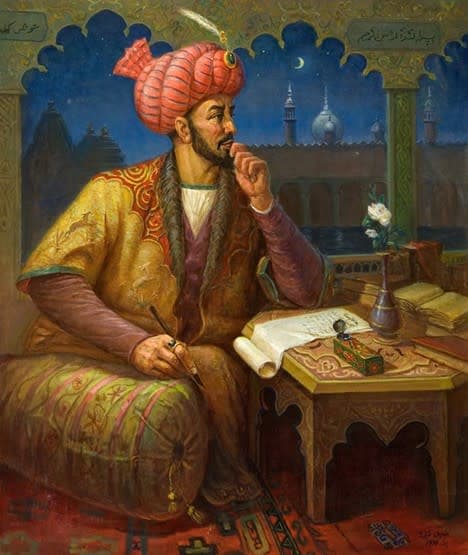

He was born on February 14, 1483, in Andijan, the capital of the Fergana appanage, to Emir Umar Shaykh Mirza II. On his father’s side Babur was a direct descendant of Tamerlane, being the great-grandson of Timur’s third son, Miran Shah. On his mother’s side he had Chinggisid roots: his mother, Qutlug Nigar Khanum, was a daughter of Yunus Khan, ruler of Moghulistan, who had been educated by Timur’s famous historian, Sharaf al-Din ‘Ali Yazdi. This dual lineage gave Babur claims to the legacy of both the great Turkic conquerors and the Mongol khans.

Babur’s native tongue was Chagatai Turkic, in which he wrote his celebrated autobiography, the Baburnama. He proudly noted that the people of his native Andijan were all Turks and that their speech was close to the literary language. In addition to Turkic, he was fluent in Persian.

In 1494, at just twelve years old, Babur inherited the Fergana appanage after his father’s accidental death. From the outset, his rule was marked by the ambitious aim of uniting all Timurid lands in Transoxiana. In 1497, after a seven-month siege, he managed to capture Samarkand, the former capital of Timur’s empire, but was forced to abandon it due to civil strife and lack of support.

In the struggle for power in Transoxiana, Babur faced a formidable opponent, the seasoned commander Muhammad Shaybani Khan, who led the nomadic Uzbek tribes. After a series of defeats Babur was expelled from Central Asia in 1504, but he seized Kabul, which became his new base. He wrote bitterly in his memoirs: “For almost one hundred and forty years the capital city of Samarkand belonged to our house; an Uzbek of unknown origin, a stranger and an enemy, came and seized it!”

In 1511 Babur made a last, desperate attempt to recover Samarkand and Bukhara after learning of Shaybani Khan’s death. To do so he was compelled to ally with the Safavid shah Ismail I, who was a Shi‘ite, whereas Babur adhered to Sunnism. In exchange for military aid, Babur agreed to become the shah’s vassal, to mint coins in his name, and even to don Qizilbash attire steps that stirred discontent among Transoxiana’s Sunni population. Although he managed to retake Samarkand for seven months, in May 1512 his forces were defeated by the Uzbeks near Bukhara, and he left Transoxiana for good, abandoning his claims to Central Asia.
Having suffered final defeat in his struggle for his homeland, Babur turned his ambitions southward to found a new state in India. From 1519 he began launching campaigns from Kabul into northwestern India. The turning point came in 1526, when, responding to an ally’s appeal, he invaded India. In the First Battle of Panipat in April 1526, Babur’s army about 15,000 strong using artillery, routed the superior forces of the Delhi sultan Ibrahim Shah Lodi, who fielded up to 1,000 war elephants.


This victory was decisive. In 1527 Babur defeated the Rajput ruler Sangram Singh (Rana Sanga), and in 1529 the army of the Bengal Sultanate. In his battles he effectively employed firearms and tactics borrowed from the Uzbeks. Moving his center of power to Agra, he founded a new state that Europeans came to call the Mughal Empire.

Babur was not only a great commander but also a gifted writer, poet, and scholar. His famous autobiography, the Baburnama, is considered the first exemplar of this genre in the historical literature of the Islamic world. In it he describes with striking candor the events of his life, the customs and manners, and the geography of the places he visited. His poems, written in Turkic, are filled with deep feeling—especially his longing for his lost homeland:
In a foreign land a man is, of course, forgotten.
Only his own heart pities him.
In all my wanderings I knew not an hour of joy.
A man forever grieves for his dear homeland.
Babur also authored works on Islamic law, poetics, and the art of war. He died in Agra on December 26, 1530, likely of dysentery. Before his death he divided his domains among his four sons, leaving the Indian lands to his eldest, Humayun. According to his will, Babur’s remains were transferred to Kabul and buried in the garden he himself had founded, where a mausoleum was later erected.


