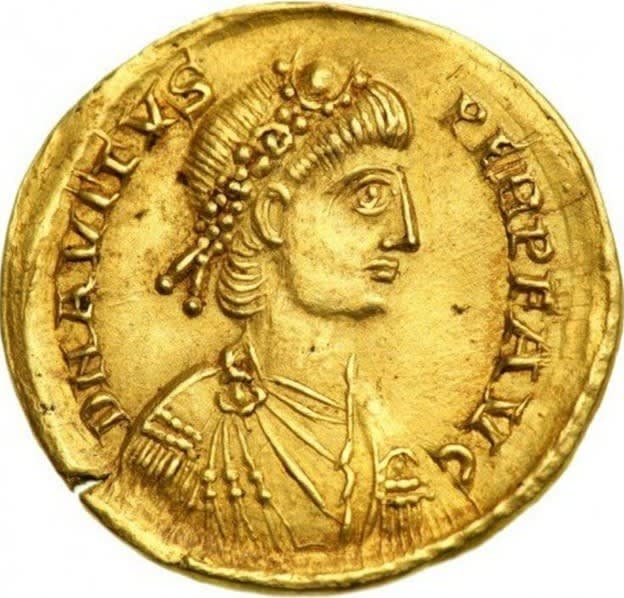
The story of Eparchius Avitus represents a unique chapter in the chronicle of the decline of the Western Roman Empire — an attempt by the Gallo-Roman aristocracy to assume responsibility for governing a fading state.
The future emperor was born in Augustonemetum, modern Clermont-Ferrand, into one of the wealthiest and most influential families of Gaul.
According to historians, his father was probably Flavius Julius Agricola, who served as consul in 421.
Avitus received a classical education appropriate to his high social standing, with particular emphasis on jurisprudence.
His personal life and political career were closely connected with several prominent figures of his age. His daughter Papianilla married the famous poet and writer Sidonius Apollinaris, whose panegyrics and letters later became invaluable sources for the history of the period.
Avitus also had two sons, Agricola and Ecdicius Avitus, the latter of whom would later distinguish himself as a patrician and magister militum.
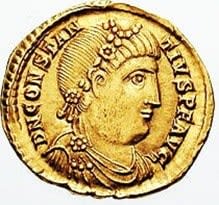
Avitus’s political career began with diplomatic success.
Even before 421, he was sent to the powerful patrician Flavius Constantius with a delicate request to reduce the tax burden imposed on Gaul, and the mission proved entirely successful.
The decisive factor in his later career, however, was his close relationship with the Visigoths.
In 425–426, Avitus travelled to Tolosa to visit his relative Theodorus, who was being held as a hostage at the court of King Theodoric I.
There he gained the king’s respect and became close to his son, the future Theodoric II, whom Avitus personally instructed in Latin poetry, introducing the barbarian prince to Roman culture.
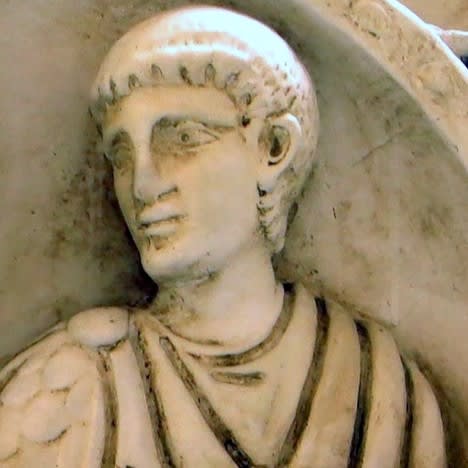
Avitus’s military career was no less distinguished.
He fought under the legendary Flavius Aetius in campaigns against the Juthungi and Norici in 430–431, and later against the Burgundians in 436.
In 437, after attaining the rank of illustris, he became magister militum of Gaul.
In this office, he not only defeated Hunnic detachments near his native Augustonemetum but also forced Theodoric I to lift the siege of Narbo.
In 439, Avitus became Praetorian Prefect of Gaul, succeeding in renewing the treaty of friendship with the Visigoths and securing a fragile peace for the region.
In 440, he decided to withdraw from public life and retired to his luxurious estate of Avitacum, where he lived quietly until the shadow of Attila once again fell over the empire.
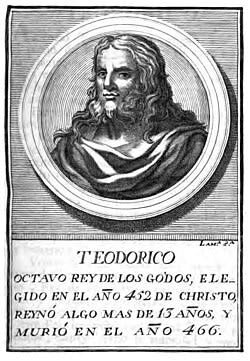
In 451, when the Huns invaded Gaul, Avitus became the crucial link that united Roman and barbarian forces.
He persuaded Theodoric I to form an alliance with Aetius, contributing directly to the victory at the Battle of the Catalaunian Plains.
Although Theodoric was killed in the battle, the alliance between Rome and the Visigoths entered history as one of the final great triumphs of the declining empire.
A new stage in Avitus’s career began in the spring of 455, when Emperor Petronius Maximus recalled him to service, appointed him magister militum, and sent him as an ambassador to Tolosa to negotiate with Theodoric II.
While Avitus was carrying out his mission among the Goths, the political world collapsed.
On 31 May, Petronius Maximus was killed, and Rome was subjected to a devastating sack by the Vandals of Genseric.
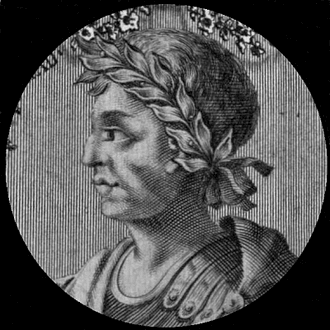
Under these circumstances, Theodoric II, who wanted a loyal emperor on the Roman throne, proclaimed Avitus Augustus at Toulouse.
On 9 July, his candidacy was approved by an assembly of representatives from the seven Gallic provinces at Ugernum, and by 5 August recognition had also come from the Roman Senate.
Avitus remained in Gaul for three months, consolidating his support, and only afterward marched toward Italy at the head of a Gallic army and Gothic contingents.
Passing through Noricum and Ravenna, where he left a Gothic detachment under the command of his loyal supporter Remistus, Avitus entered Rome in triumph on 21 September 455.
His position, however, was extremely fragile.
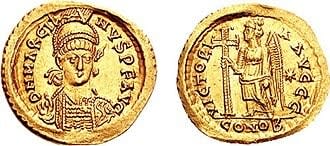
He needed recognition from the Eastern emperor Marcian, as well as the support of two powerful military commanders — Majorian and Ricimer.
When Avitus assumed the consulship on 1 January 456, he encountered his first serious political challenge: the Eastern court refused to recognize his authority and appointed its own consuls.
In foreign policy, Avitus attempted to contain the Vandals, who continued attacking the Italian coastline.
Although he managed to secure a winter truce, by March 456 the Vandals had already devastated Capua.
The counterattack was led by Ricimer, who twice defeated Genseric’s fleet and army near the coasts of Sicily and Corsica.
Meanwhile, the Visigoths, formally acting under Avitus’s authority, expanded their territories in Spain.
They crushed the Suebi at the Battle of the Paramus Plain on 5 October 456, an outcome that effectively amounted to Gothic occupation of the province.
Discontent with Avitus’s rule in Italy grew rapidly.
The Roman aristocracy was outraged that key positions in the imperial administration had been given to Gallo-Romans.
The situation was made worse by a severe food crisis and the lack of money in the imperial treasury.
In order to pay the Gothic guard before dismissing it, Avitus was forced to take an extremely unpopular measure: he ordered the bronze statues of Rome to be melted down and sold.
This proved to be the final straw.
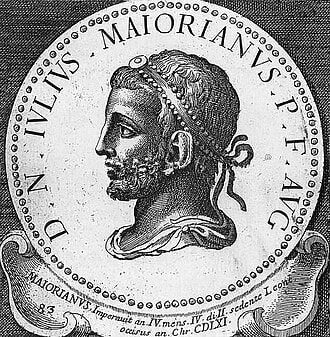
Taking advantage of popular anger and their own growing influence, Ricimer and Majorian rebelled.
In the autumn of 456, Avitus fled Rome.
On 17 September, the Senate formally deposed him, while Remistus was killed at Ravenna.
Attempting to regain power, Avitus gathered the remnants of his loyal forces and marched against Ricimer.
The decisive battle took place near Placentia on 17 or 18 October 456.
Avitus suffered a crushing defeat and lost his newly appointed magister militum, Messianus.
He was captured.
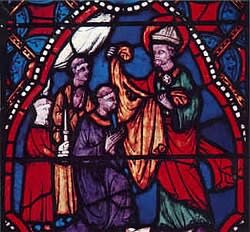
Ricimer spared his life but forced him to enter the clergy, appointing him bishop of Placentia.
The circumstances of Avitus’s death remain mysterious and are surrounded by competing accounts.
Although some supporters in Gaul continued to recognize him as emperor for another year, and Hydatius referred to 457 as the third year of his reign, Avitus did not survive until the end of that year.
According to one version, the Senate sentenced him to death in absentia, and he died while attempting to flee to Gaul and reach the Basilica of Saint Julian.
According to another account, he was either strangled or starved to death on Majorian’s orders.
Avitus was finally laid to rest at Brivas, near the tomb of Saint Julian.
With his death, hopes for a durable political alliance between Rome and the Gallo-Roman aristocracy effectively disappeared, leaving the empire increasingly vulnerable to both barbarian powers and the ambitions of military commanders.


