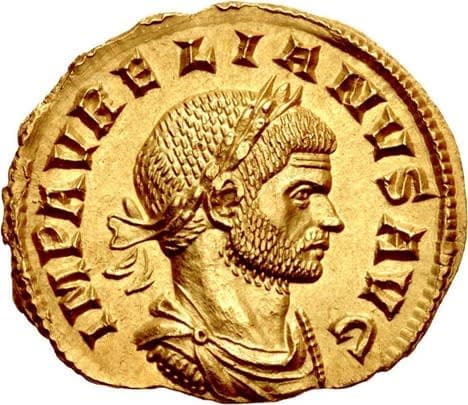

Aurelian was born in 214 into a humble family. From an early age he proved himself a bold and resolute soldier. His military career advanced rapidly: he served in the VI Gallic Legion, took part in campaigns against the Franks and Goths, and under Emperor Gallienus he commanded a cavalry detachment.

After Gallienus was assassinated in 268, Aurelian backed the new emperor, Claudius II, under whom he reached the height of his military career, becoming commander of all the Roman cavalry. His cavalry played a key role at the Battle of Naissus, where the Romans inflicted a crushing defeat on the Goths. Aurelian then campaigned successfully against barbarian peoples in the Balkans, earning a reputation as an outstanding general. In 270, after Claudius died of plague, Aurelian was proclaimed emperor by the Pannonian legions. His rival, Quintillus, realizing he lacked army support, committed suicide, clearing Aurelian’s path to the throne.
When Aurelian became emperor, the Roman Empire was in deep crisis. It was split into three parts—the core Roman Empire, the Gallic Empire in the west, and the Palmyrene Kingdom in the east. In addition, the frontiers suffered continual barbarian raids.


Aurelian began his reign by dealing with external enemies. First he defeated the Vandals who had invaded Pannonia, forcing them back across the Danube. He then faced an incursion by the Alemanni, Marcomanni, and Juthungi, who broke into Italy and even routed his army in an initial battle. Aurelian quickly regrouped, defeated them in two decisive engagements, and destroyed them. After these victories he returned to Rome and ordered the construction of the Aurelian Wall to protect the capital.

He then moved to the Balkans, where he defeated the Goths in several battles. Aurelian made a wise but painful decision to abandon the province of Dacia, as it was too costly to maintain. He transferred troops and population south of the Danube, strengthening the new frontier.

In 272 Aurelian launched a campaign to recover the eastern provinces ruled by Queen Zenobia. His huge army, numbering over 200,000 men, crossed the Bosporus. Along the way many cities, including Tiana, surrendered without a fight. In two decisive battles, at Immae and Emesa, he crushed Zenobia’s forces. The queen fled to Palmyra but was captured. The city surrendered and, after a renewed uprising, was razed to the ground. Zenobia was paraded in a triumph at Rome, but her life was spared.

In 274, after returning to Rome, Aurelian headed west to reclaim Gaul, which was ruled by the emperor Tetricus I. In the decisive Battle of Châlons-sur-Marne he won a victory, and Tetricus surrendered, dissatisfied with his own subordinates. Thus, in just five years, Aurelian reunited the Roman Empire and earned the title “Restorer of Peace.”
Aurelian’s reign was marked by important reforms. He introduced the cult of the Unconquered Sun (Sol Invictus) as the supreme deity, seeking to create a unifying religion for the entire empire. He also carried out a currency reform, issuing new coinage, and strengthened the army by increasing the role of heavy cavalry.
Despite his severity, Aurelian enjoyed great authority in the army, though his relations with the Senate were tense. In 275 he resolved to launch a campaign against Persia, but was assassinated in a conspiracy near the city of Byzantium.
Though it lasted only five years, Aurelian’s reign was the last brilliant moment in the history of the Roman Empire before its final decline. His principal achievement—the restoration of the empire’s unity—was highly esteemed by contemporaries, who compared him to Alexander the Great and Caesar.


