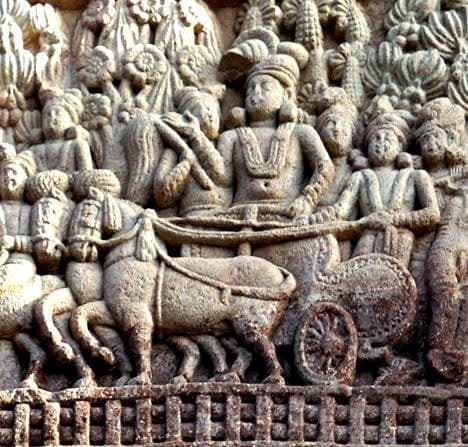

The biography of Ashoka one of ancient India’s greatest rulers has come down to us mainly through Buddhist literature written some three centuries after his death. Though hagiographic in tone, these sources allow us to reconstruct his life’s course. Ashoka, grandson of Chandragupta Maurya and son of Bindusara, was far from the foremost claimant to the throne. He was not noted for striking looks, but surpassed his brothers in valor and administrative skill. In his youth he proved himself a gifted commander and governor by suppressing a revolt in Taxila that his elder brother had failed to quell. This won his father’s attention, and Ashoka was appointed governor of Avanti.

After Bindusara’s death in 272 BCE, Ashoka—backed by courtiers—was crowned. His formal coronation, however, took place only four years later, apparently due to a struggle for power. Legends claim he killed all his brothers, but this is not supported by historical evidence; in his own edicts he mentions his brothers with affection.
The key event that reshaped Ashoka’s reign was the conquest of Kalinga, eight years after his accession. In this bloody conflict more than 100,000 people were killed and 150,000 taken prisoner. Though the victory brought him a strategically vital territory, the suffering, death, and devastation he witnessed led to profound remorse. In one edict he confesses: “Now Devanampiya deeply regrets the conquest of Kalinga.” This was a turning point: rejecting violence, Ashoka embraced Buddhism.

After adopting Buddhism, Ashoka began to promulgate the Dhamma a moral law grounded in tolerance, compassion, and non-violence. He issued 33 inscriptions (the Edicts of Ashoka), carved on pillars and rocks across the empire, in which he set out the principles of his new rule. Unlike hagiographic texts, these edicts are the most reliable sources for his biography.
Ashoka abolished forced labor, banned hunting for sport, established a list of protected animals, and organized the cultivation of medicinal plants for people and animals. He created a network of free hostels, canals, and irrigation systems.
Although a Buddhist who actively supported the sangha, Ashoka’s cardinal principle was religious tolerance. In his edicts he urged respect for all religions and sects, even granting caves to his opponents, the Ajivikas. Only late in his reign did he perhaps deviate from this principle, leading to conflicts.
Ashoka was the first Indian king to promote Buddhism actively beyond his empire. He sent missionaries including his son Mahinda to Sri Lanka, where Buddhism became the state religion.


Ashoka’s empire was among the most extensive in ancient India, stretching from the Himalayas to the southern peninsula. In his final years, according to Buddhist sources, his lavish generosity toward the Buddhist community exhausted the treasury. Power effectively passed to his grandson Sampadi, a supporter of Jainism, who halted the donations.

After Ashoka’s death the Maurya Empire gradually declined and fell in 180 BCE. The memory of Ashoka was almost erased by Brahmins, who opposed his anti-caste policies and ban on animal sacrifice. In the 19th century, however, the English scholar James Prinsep deciphered Ashoka’s edicts, restoring his name to history. Today, the image of Ashoka as a wise and compassionate ruler symbolizes Indian statehood, and the capital atop his pillars has become India’s state emblem.


