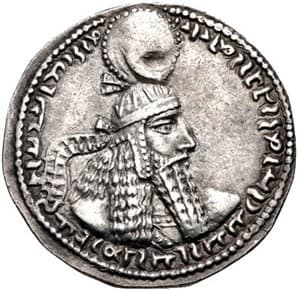

At the beginning of the third century AD, the Parthian kingdom weakened by internal strife and the Roman invasion of 217 was in deep crisis. After the death of the Parthian “king of kings” Vologases V, his sons Vologases VI and Artabanus V split the country in a civil struggle, leaving it vulnerable. In this period, in the southern region of Iran, in Pars, a new strong leader emerged: Ardashir Papakan, the founder of the Sasanian Empire.
Ardashir came from a noble lineage that traced its ancestry to the legendary Bahman, who was connected with the Achaemenids. His grandfather Sasan and his father Papak were high priests of the temple of Anahita in Istakhr. Ardashir himself, as commander of the fortress of Darabgerd, gradually expanded his domains, subduing neighboring principalities. Around 212, together with his father, he overthrew and killed the powerful prince Gochihra, establishing his rule in Pars.
Once secure in Pars, Ardashir began an active northward expansion. His advance into Khuzestan posed a direct threat to the Parthian government. In 223 his combined army besieged and captured Seleucia-on-the-Tigris, the residence of Vologases VI, and Vologases himself perished.
Ardashir then turned his attention to Artabanus V. Although sources are contradictory, it is generally held that the decisive battle took place on the plain of Hormizdagan. In 224 Ardashir defeated and killed Artabanus, after which he proclaimed himself shahanshah—“king of kings.” This event ended nearly five centuries of Arsacid rule and marked the beginning of a new era in the history of Iran. Yet only in 227 was Ardashir formally crowned, indicating the need to suppress the last pockets of resistance.


The Sasanian rise to power was not a simple dynastic coup. Ardashir sought to create a centralized state with a unified religion, in contrast to fragmented Parthia. He actively supported the Zoroastrian church, and the high priest Tansar undertook the codification of the Avesta. Ardashir saw religion as the buttress of the state an idea that became a key concept of Sasanian rule.
Ardashir also pursued an aggressive foreign policy. After defeating Parthia, he campaigned eastward, subjugating lands in Sistan, Gurgan, Merv, and Balkh, and asserting authority over part of the Kushan realm.

He then turned westward, toward the Roman frontier. Around 230 his forces began raids into Roman territories in Mesopotamia, aiming to reclaim lands that, in his view, had belonged to the Persian Empire since Achaemenid times. In 231 the emperor Alexander Severus personally led a campaign against Ardashir, but the war seesawed. Though both sides suffered heavy losses, Ardashir continued the offensive. In 237–238 he captured a number of important Roman cities, including Nisibis and Carrhae.
Ardashir Papakan laid the foundations of a powerful Sasanian Empire that for the next four centuries successfully confronted first the Roman and then the Byzantine Empire. He left behind not only a strong state but also a rich cultural legacy, including a tradition of rock reliefs that celebrated his victories and affirmed the legitimacy of the new dynasty. In the Muslim historical tradition he remained a symbol of a wise and successful ruler. Ardashir died in 240, passing the throne to his son Shapur I.



