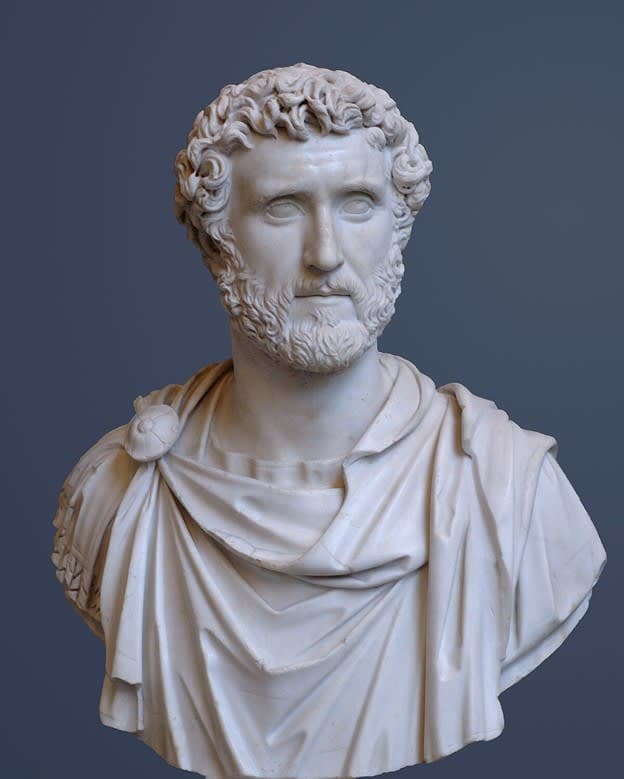

The future emperor Antoninus Pius was born on September 19, 86 CE, on his parents’ estate near Rome. His family, the Aurelii, hailed from Gaul. His father, Titus Aurelius Fulvus, was a consul, and his grandfather twice consul and prefect of Rome. Antoninus’s mother was Arria Fadilla.

Antoninus grew up at Lorium, not far from Rome, and seems always to have regarded it as his true home. He lost his father at the age of three and was raised by both grandfathers. In the early second century he began his career, serving as quaestor, praetor, and ordinary consul in 120.
After his consulship Antoninus withdrew from public life, but Emperor Hadrian appointed him one of the four consulars who administered Italy’s judicial districts a very prestigious office that demanded complete loyalty. From 133 to 136 Antoninus served as proconsul of Asia, where he earned an excellent reputation. He favored peaceful, lenient solutions, which drew Hadrian’s attention.

In January 138 Hadrian’s adopted son and heir, Lucius Aelius Caesar, died suddenly. Hadrian chose Antoninus as his new heir. On February 25 he was formally adopted and received tribunician power and proconsular authority on the condition that he in turn adopt two youths, Marcus Aurelius and Lucius Verus.
When Hadrian died, Antoninus peacefully ascended the throne. The Senate, displeased with Hadrian and intending to pronounce damnatio memoriae upon him, opposed the move. Antoninus, for his part, wished to deify his predecessor a step that also touched upon the legitimacy of his own power. Fearing army intervention, the Senate yielded. For his efforts to secure Hadrian’s deification Antoninus received the cognomen “Pius” (the Dutiful). In 139 he accepted the title “Father of the Fatherland.”
Antoninus Pius attached great importance to legal activity, laying the groundwork for the flourishing of Roman law in the third century. He emphasized equality among social orders and introduced new principles based on that idea, aided by the eminent jurists of his day.
The emperor worked to improve the condition of slaves: he eased manumission procedures and equated a master’s killing of his own slave with ordinary homicide. He also decreed those slaves seeking sanctuary in temples were not to be returned to their owners. In criminal law he affirmed the principle of the presumption of innocence and softened the use of torture.
Antoninus’s building activity was less grandiose than that of his predecessors, but he completed Hadrian’s Mausoleum and built temples in honor of the deified Hadrian and Faustina. He also restored a number of older structures in Rome, including the Colosseum.


Upon taking power Antoninus abolished the tax imposed on the occasion of his adoption. After the death of his wife, Faustina the Elder, in 141, he deified her and founded the charitable fund “Faustinian Girls” to aid orphaned girls.
He remained highly accessible to his subjects and closely supervised the procurators, demanding reports and forcing them to return ill-gotten gains.
In 148 Rome celebrated the 900th anniversary of its founding with grand games. The expenses of the festivities and the costs of disaster relief (earthquakes and fires), however, led to a debasement of the denarius. Despite this, by the end of Antoninus’s reign the imperial treasury held a vast surplus.

Unlike his predecessors, Antoninus Pius was deeply religious and worshiped only the traditional Roman gods. He sought to revive the old republican spirit of piety and reverence for the gods. In honor of Rome’s 900th anniversary, coins were struck depicting scenes from ancient mythology.
Despite his convictions, Antoninus did not persecute Christians en masse. He continued the policy of non-intervention begun by Trajan and Hadrian: Christians were not prosecuted unless specific charges were brought. Even so, there were cases of martyrdom during his reign, such as the deaths of Publius, bishop of Athens, and Polycarp, bishop of the church at Smyrna.
Antoninus’s reign was the most peaceful in the history of the Principate. He was not a battlefield commander; all military operations were conducted by his legates. Overall command of the army was exercised by Marcus Gavius Maximus, who served as praetorian prefect for twenty years.
The most active theater of policy was Britain. In 139 Antoninus appointed Quintus Lollius Urbicus as legate; he crushed a British uprising and pushed the frontier north. In 142 construction began on the Antonine Wall, a turf rampart 58 kilometers long between the Firth of Forth and the Firth of Clyde. For these successes the emperor received the acclamation “Imperator” for the second time.


On the Rhine and Danube frontiers the limes was also strengthened and advanced some thirty miles; new settlements and roads were built. The Quadi received a new king with Antoninus’s consent, an event noted on the coinage.
Between 144 and 152 conflict flared with the Mauri in the North African provinces. It was suppressed, and new fortifications were built to secure the frontier. In Numidia the Romans laid a new road and built an aqueduct.
During Antoninus’s reign there were small uprisings in Achaea, Egypt, and Judea; all were quickly put down. Antoninus softened Hadrian’s ban on circumcision but required Jews to refrain from recruiting proselytes.

The Historia Augusta describes Antoninus as tall and stately, though bent with age. He was so just and kind that, in the words of Aurelius Victor, he proved that peace and tranquility do not corrupt noble characters. On the Bay bust he appears calm and restrained, with a noble and dignified expression.
Antoninus Pius died of a fever on March 7, 161, at his villa at Lorium. Before his death he formally named Marcus Aurelius as his successor. His funeral was magnificent; he was deified, and a triumphal column was raised in his honor.
Historians call Antoninus Pius a second Numa Pompilius for his love of peace, justice, and religion. Edward Gibbon counted him among the “Five Good Emperors.” Under his rule the provinces reached their height. The Greek orator Aelius Aristides described the Rome of Antoninus in rapturous terms as the common fatherland of all people, where anyone could travel freely. Some historians, however, criticize him for passivity and neglect of the army, which they see as sowing problems for his successor.


