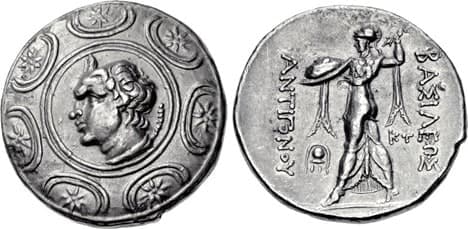
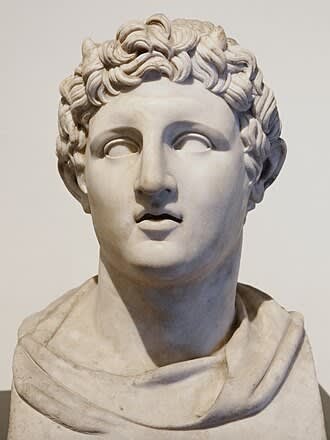
The fate of Antigonus II Gonatas, one of the most remarkable rulers of the Hellenistic age, was forged in the furnace of constant warfare and immense upheaval. His childhood and youth coincided with the first and bloodiest decades of the Wars of the Diadochi — the generals who fought over the vast inheritance of Alexander the Great.
Antigonus came from an extraordinarily distinguished family. His father was the famous commander Demetrius I Poliorcetes, his mother was Phila, daughter of the powerful regent Antipater, and his brother was the well-known historian Craterus. From an early age, Antigonus absorbed the art of government and survival in a world where crowns were won and lost on the battlefield.
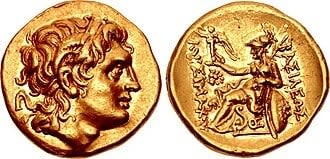
Even after his crushing defeat in the great Battle of Ipsus, Demetrius I Poliorcetes managed to preserve significant political and military influence in the Balkans for another fifteen years.
When Demetrius set out on his final campaign against Seleucus I, he entrusted Antigonus with the administration of his affairs in Greece. When Demetrius finally disappeared from the political stage in 286 BC, his son demonstrated remarkable political skill: he successfully retained control of the key Macedonian garrisons at Acrocorinth, Chalcis, and Demetrias.
These three seemingly impregnable fortresses were not without reason known to contemporaries as the “Fetters of Greece.” Whoever controlled them effectively held the fate of the Greek world in his hands.
The deaths of the last great Diadochi, Lysimachus and Seleucus, in 281 BC opened a new chapter in the struggle for power, and Antigonus immediately attempted to seize Macedonia.
Fortune, however, did not favor him.
That same year he suffered defeat in a major naval battle against Ptolemy Ceraunus, who briefly seized the Macedonian throne.
Forced to retreat to Asia Minor, Antigonus became embroiled in an exhausting war against Antiochus I.
Meanwhile, catastrophe struck the Balkans. A massive Celtic invasion plunged Macedonia into complete anarchy, accompanied by the rapid and chaotic succession of rival rulers.
Recognizing a historic opportunity, Antigonus made a sudden landing near the Hellespont in 277 BC.
At the decisive Battle of Lysimachia, he inflicted a crushing defeat upon the Celtic hordes.
This brilliant victory opened the road to the goal he had pursued for years. After concluding a strategic alliance with the Aetolians and recruiting an impressive force of 9,000 Celtic warriors into his army, Antigonus Gonatas finally ascended the Macedonian throne in 276 BC.
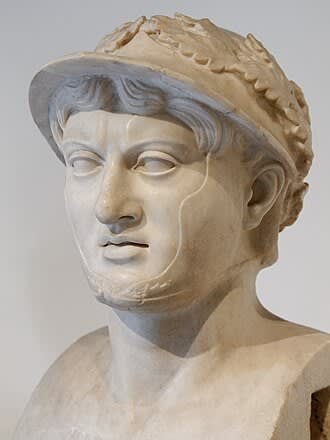
No sooner had the new monarch placed the crown upon his head than he faced the difficult task of restoring order in Greek affairs, where the hostile and increasingly powerful Achaean League was gaining strength in the Peloponnese.
His ambitious plans, however, were abruptly interrupted.
In 274 BC, the celebrated commander and king of Epirus, Pyrrhus, invaded Macedonia.
Antigonus fearlessly marched against him at the head of his mercenary army, whose core consisted of Celtic troops, but suffered a severe defeat.
He lost control of Thessaly, Upper Macedonia, and even the ancient sacred capital of Aegae, forcing him to seek refuge behind the walls of Thessalonica.
Unwilling to accept the loss of his kingdom, Antigonus assembled another mercenary army in 273 BC and launched a counterattack into Epirus.
Once again, however, fortune turned against him. Antigonus’s army was defeated by Ptolemy, the son of Pyrrhus, and the Macedonian king was once more forced to retreat toward the coast.
The situation changed completely in 272 BC, when the restless Pyrrhus marched into the Peloponnese to attack Sparta.
Taking advantage of his enemy’s exposed rear, Antigonus rapidly restored his control over Macedonia and immediately pursued the Epirote army.
During the fierce nighttime assault on Argos, Pyrrhus was killed. From that moment onward, there was effectively no one left capable of seriously challenging Antigonus’s authority in Macedonia.
With his most dangerous enemy eliminated, the Macedonian king began systematically strengthening his position in the Peloponnese by establishing loyal tyrannical regimes in various cities.
Demonstrating considerable political flexibility, he avoided filling Greece with large Macedonian garrisons, stationing troops only in strategically important locations such as Troezen, Mantinea, and Acrocorinth.
Acrocorinth was particularly vital, as control of the fortress provided a secure grip over the entire peninsula.
Macedonian troops also remained stationed at Chalcis and Demetrias.
These carefully calculated measures finally brought Greece a long-awaited, although relative, period of peace. The Celtic mercenaries remained quiet, while the Aetolians were forced to abandon their aggressive policies.
Macedonia gained valuable breathing space and began restoring its domestic economy while strengthening its international position.
Peace, however, proved short-lived.
In 267–266 BC, a major conflict erupted that became known as the Chremonidean War.
Encouraged by Chremonides, a prominent adviser associated with the Egyptian monarch Ptolemy Philadelphus, Athens proudly declared its independence.
Until then, Ptolemaic Egypt had generally avoided direct intervention in Balkan affairs. But the growing strength of the Macedonian fleet, which in cooperation with pirates had become a dominant force in the Aegean Sea, caused increasing concern in Alexandria.
Formally, Athens declared the war. In reality, the conflict became a grand confrontation between Egypt and Macedonia.
Upon learning of the revolt, Antigonus acted with extraordinary speed.
His army invaded Attica and surrounded Athens with a tight siege, greatly aided by the fact that the Macedonians firmly controlled Piraeus.
At the same time, an Egyptian fleet sailed from Alexandria, while Sparta and several Peloponnesian states joined the anti-Macedonian uprising.
Antigonus’s strategic arrangements, however, proved highly effective.
The Spartans and their allies were trapped in the Peloponnese by the Macedonian garrison at Corinth and were unable to break through to assist Athens.
The Egyptian landing force in Attica likewise achieved no significant success.
At this critical moment, a dangerous revolt broke out among Celtic mercenaries in Megara, men who had previously served Antigonus himself.
The Macedonian king personally led the punitive expedition and crushed the rebels mercilessly in open battle.
The following year, the conflict reached its climax.
The Spartans made a desperate attempt to break through the blockade and attacked Antigonus’s positions near Corinth.
A massive battle followed, in which the Spartan army was decisively defeated.
King Areus I of Sparta was killed on the battlefield, as was Antigonus’s own son, Alcyoneus.
Areus’s successor, Acrotatus II, realizing the hopelessness of further attacks on Corinth, redirected his forces against Megalopolis, which had remained loyal to Macedonia.
But Aristodemus, the tyrant of Megalopolis, inflicted another devastating defeat upon the Spartans.
As a result, Sparta lost a second ruler during the same war — Acrotatus himself.
While Antigonus was consumed by the war in the south, Macedonia itself suddenly faced a mortal threat.
Alexander II, king of Epirus, took advantage of the absence of the main Macedonian forces and launched a treacherous invasion into the exhausted kingdom.
Antigonus was forced to take an extremely difficult step: he lifted the siege of Athens, concluded a temporary peace, and marched rapidly north to save his homeland.
There catastrophe awaited him.
In the very first confrontation, Antigonus was defeated, and his army defected to the enemy.
Salvation came from an unexpected direction.
The king’s younger brother, the teenage Demetrius the Fair, displayed remarkable military talent.
At the historic Battle of Derdia, he defeated Alexander of Epirus and triumphantly restored Thessaly and Upper Macedonia to Macedonian control.
Having restored order at home, Antigonus Gonatas suddenly returned to Athens.
At the same time, his highly effective intelligence network reported that a powerful reinforcement fleet from Alexandria was rushing to join the Egyptian squadron already anchored near Athens.
Recognizing that delay could prove fatal, Antigonus refused to allow the enemy fleets to unite.
He brought his navy into the open sea and shattered the Egyptians in the epoch-making Battle of Cos.
This brilliant victory restored undisputed Macedonian supremacy in the Aegean Sea.
Antigonus seized the coast of Caria, gained control over the entire Cyclades, restored Macedonian authority over Euboea, and triumphantly assumed leadership of the League of the Islanders.
In the autumn of 262 BC, after exhausting its resources and enduring the unimaginable horrors of a prolonged siege and widespread famine, Athens finally surrendered.
Macedonian military contingents were immediately stationed in conquered Athens, as well as in Megara, Epidaurus, and Troezen.
In 261 BC, the Chremonidean War formally ended in a complete Macedonian victory.
Having defeated both his external and internal enemies, Antigonus devoted himself to extensive state-building.
Greece was brought firmly under control. Athens remained under the strict supervision of Macedonian garrisons, while loyal tyrants ruled Argos, Megalopolis, and other important centers of the Peloponnese with a firm hand.
Epirus, once a formidable rival, was reduced to the status of a secondary and dependent state, where the monarchy itself was eventually abolished.
The powerful Aetolian League maintained a visibly loyal attitude toward the Macedonian crown.
Antigonus also achieved an important diplomatic victory against Egypt.
He arranged a dynastic marriage between his brother Demetrius the Fair and the daughter of the ruler of Cyrene. Through this alliance, strategically important Cyrenaica was permanently separated from the Ptolemaic kingdom.
Having secured a stable and seemingly unbreakable rear throughout the Balkans, the king turned to deep internal reforms aimed at strengthening the economy and rapidly increasing state revenues.
His capable administration produced an extraordinary strengthening of Macedonia and an unprecedented expansion of its influence throughout the eastern Mediterranean.
Concerned with the development of the kingdom’s territories, Antigonus also founded a new city in the north, naming it Antigonia after himself. Today the settlement is known as Negotino.
Nevertheless, Antigonus remained under constant pressure until the end of his life, repeatedly countering the intrigues of the Ptolemies, who never abandoned their attempts to undermine Macedonian authority in the Peloponnese.
In 252 BC, Egyptian agents succeeded in provoking Antigonus’s relative Alexander, who treacherously seized Acrocorinth and proclaimed himself an independent ruler.
Macedonia responded forcefully.
In 246 BC — or according to other accounts, 245 BC — the Macedonian fleet inflicted another major defeat upon the Egyptians in the great naval Battle of Andros.
When the rebellious Alexander died in 243 BC, Antigonus immediately restored his control over Corinth.
Entering into a tactical alliance with the Aetolians against the Achaeans, he also restored the exiled king Leonidas to the Spartan throne.
Although Corinth eventually joined the Achaean League, these measures allowed Antigonus to preserve dominant influence in the Peloponnese.
The prolonged confrontation finally ended with a peace treaty concluded with the Achaean League in 241 BC, formally recognizing the existing balance of power.
After living a long and extraordinarily eventful life, Antigonus Gonatas died peacefully in 239 BC, leaving behind a powerful, prosperous, and stable kingdom to his son, Demetrius II Aetolicus.
In the memory of later generations, Antigonus survived not only as a decisive, energetic, and farsighted statesman capable of following difficult and indirect paths in pursuit of great goals, but also as a man of remarkable generosity who was largely free from petty vindictiveness.
His personality was deep and complex.
As a young man, Antigonus had studied under the philosopher Euphantus of Olynthus, and he retained a love of intellectual pursuits throughout his life.
A particularly close and affectionate friendship connected the powerful monarch with the famous Stoic philosopher Zeno of Citium.
When the philosopher died, Antigonus personally set aside affairs of state and arranged an extraordinarily magnificent funeral for his wise friend, paying a final tribute to one of the great minds of his age.


