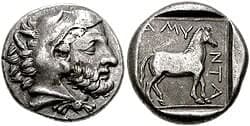
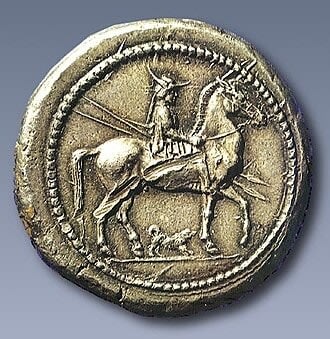
The genealogy of Amyntas III is surrounded by disputes among ancient authors. The Roman historian Justin called him the son of Menelaus and the nephew of the famous Alexander I, while Claudius Aelian, agreeing on the name of his father, repeated biting anecdotes claiming that Menelaus had been illegitimate and that Amyntas himself had supposedly begun his career as a slave at the court of Aeropus II.
Most likely, however, Roman authors confused him with his namesake, Amyntas II. Modern historiography, drawing in particular on the research of K. J. Beloch, tends to identify Amyntas’s father as Arrhidaeus, a grandson of Alexander I.
Despite disagreements over the details, all sources agree on the essential point: Amyntas belonged to the sacred Argead dynasty, which traced its ancestry back to Heracles himself.
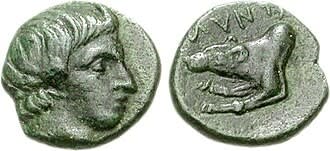
Amyntas’s accession was preceded by a period of turmoil that had begun with the assassination of King Archelaus in 399 BC.
Within a remarkably short period, the Macedonian throne became the prize in a dizzying succession of rulers. After Archelaus, Crateuas seized power for only a few days. He was followed by the young Orestes under the regency of Aeropus.
After Aeropus’s death in 394–393 BC, the struggle for power reached its peak. Within a single year, Macedonia passed through several rulers: Amyntas II was killed by the Elimeian ruler Derdas, while Pausanias, the son of Aeropus, was overthrown by Amyntas III himself.
Most historians date the beginning of Amyntas III’s long and difficult reign to 393 or 392 BC, although other chronological reconstructions place his accession somewhat later, toward the end of the 390s.

Amyntas had barely secured the throne when Macedonia faced an existential threat from the Illyrians under their formidable leader Bardylis.
The barbarian offensive was so devastating that Amyntas was forced to flee, while a puppet ruler named Argaeus was placed on the throne, according to Diodorus.
In an attempt to preserve what remained of his influence, Amyntas took a desperate step. He concluded a fifty-year defensive alliance with the Chalcidian League, led by Olynthus, handing over significant eastern territories — including Mygdonia and Anthemus — for administration and granting extensive commercial privileges.
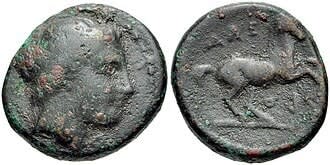
The fate of Argaeus II and the circumstances of Amyntas’s return remain subjects of scholarly debate.
According to one reconstruction, Amyntas regained the crown only two years later with the assistance of Thessalian allies or Spartan mercenaries.
Other scholars, including K. J. Beloch and A. S. Shofman, argue that the Illyrian invasion and the accession of Argaeus occurred later, around 385 BC.
Particularly striking is the testimony of Isocrates, who described Amyntas’s recovery as almost miraculous. Having lost nearly the entire kingdom and retaining only a “small piece of land,” Amyntas supposedly managed to regain control of his state within three months.
His triumph, however, was overshadowed by the refusal of Olynthus to return the lands it had received during Macedonia’s hour of desperation.
By the middle of the 380s BC, Macedonia found itself surrounded by enemies: the Illyrians in the west, the Thracians in the north, and the aggressively expanding Chalcidian League in the east.
The Olynthians seized almost the entire kingdom, including one of its capitals, Pella. The king’s possessions were reduced to a narrow strip of Pieria around Aegae.
In this critical situation, Amyntas revealed himself as an exceptional diplomat by appealing to Sparta for assistance.
The Spartans, alarmed by the growing power of Olynthus and its alliance with Athens, saw Macedonia as a necessary buffer state and as a guarantor of the safe passage of Spartan armies.
The war began in 382 BC.
The Spartan commanders Eudamidas, Teleutias, and King Agesipolis I conducted a prolonged campaign. Despite the deaths of senior commanders and outbreaks of disease, the siege of Olynthus continued.
In 379 BC, the city finally surrendered.
The Chalcidian League was dissolved, and Amyntas III at last reunited his kingdom, recovering the territories that had previously been lost.
During the same period, Macedonia strengthened its ties with the Odrysian Kingdom.
The Athenian general Iphicrates, acting in the interests of the Thracian king Cotys I, impressed Amyntas so greatly with his military achievements that the Macedonian monarch formally adopted him.
This act not only strengthened dynastic and diplomatic ties, but also helped lay the foundations for future military reforms. It was partly after the example of Iphicrates that the transformation of Macedonian infantry would later begin.
Having secured his frontiers, Amyntas III devoted the final years of his reign to a more subtle political game.
He understood that Spartan power was declining and therefore began moving closer to Athens, which had a strong interest in Macedonian shipbuilding timber.
An alliance was concluded in 375 or 373 BC, and in 371 BC the Macedonian representative at a Panhellenic congress supported Athens’s claims to Amphipolis.
The king also actively intervened in Thessalian affairs, forming an alliance with Jason of Pherae and acting as a mediator in border disputes among neighboring states.
Life within the royal court was no less turbulent.
Amyntas married Eurydice, a woman from a noble Lyncestian family, possibly of Illyrian origin.
This marriage was a strategic move intended to stabilize Macedonia’s western frontier.
Eurydice gave birth to three future kings: Alexander II, Perdiccas III, and the great Philip II of Macedon.
Amyntas also had a second wife, Gygaea, who belonged to the Argead dynasty. Her sons would later become rivals of Philip in the struggle for power.
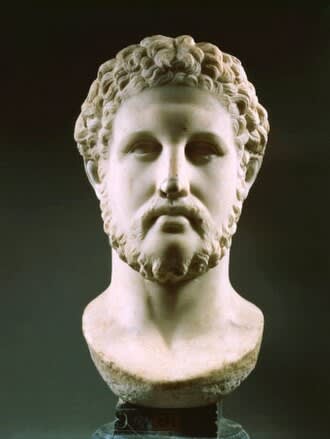
History also preserved dark rumors of a conspiracy by Eurydice against her husband.
Justin reports that she planned to murder Amyntas and marry her son-in-law, who was allegedly also her lover, but the plot was exposed by their daughter Eurynoe.
The king nevertheless spared his wife for the sake of their children.
It is also noteworthy that Amyntas’s court physician was Nicomachus, whose son — the future philosopher Aristotle — spent part of his childhood at the Macedonian court. This connection would later have a profound influence on the cultural and intellectual direction of Macedonia.
Amyntas III died at an advanced age in 370 or 369 BC, leaving the throne to his eldest son Alexander.
His reign, which lasted twenty-four years, became a model of political survival.
As the historian E. Borza observed, Amyntas ruled a country that was in a “wretched condition,” and it was only through his ability to make timely concessions, forge alliances, and maneuver among the interests of greater powers that he managed to preserve Macedonia’s integrity.
He left his sons not merely a territory, but a restored monarchy with a functioning assembly of armed citizens and renewed suzerainty over the tribes of Upper Macedonia.
Although the identification of his tomb at Aegae, modern Vergina, remains disputed among archaeologists, his greatest monument was Macedonia itself — the kingdom he saved from collapse and prepared for the extraordinary achievements of his son Philip and his grandson Alexander the Great.


