The end of the Seven Years’ War in 1763 became a turning point in relations between the British Empire and its American colonies. Having signed the Treaty of Paris with France and Spain, Britain received vast territories, including Canada and the lands east of the Mississippi. This sudden expansion called into question the future stability of the empire. As the historian Linda Colley wrote, the English gained too much power over too many people, and Lord Bedford believed that Britain had become “too great.”


The presence of French holdings in Canada before the war forced the colonies to rely on the mother country for protection, but with the disappearance of this threat their dependence began to weaken. At the same time, the British government, faced with a huge foreign debt after the war, decided that the colonies should bear part of the financial burden.
The Thirteen Colonies, from the moment of their founding, had their own representative bodies and did not pay taxes into the British treasury. Until 1764 the British Parliament did not use its right to tax the colonies, which fostered among Americans the belief that Parliament had no such rights. Therefore, when in 1763 George Grenville’s cabinet decided to bring the colonies under the power of Parliament and force them to finance the maintenance of 8,500 British soldiers in America, this came as a surprise. The first step toward this was the Sugar Act passed in 1764, and then, on March 22, 1765, the Stamp Act.

The adoption of the Stamp Act sparked a storm of indignation. Although the protest of the Virginia House of Burgesses, led by Patrick Henry, was rejected, it became the first official statement against the law. In May 1765 popular demonstrations began. In Newport and Charleston crowds smashed the homes of supporters of the law, and in Boston mass riots took place. As John Adams later recalled, “the child Independence was born in the days of the Stamp Act crisis.” The so-called “Stamp Act Congress” convened in New York, which adopted the “Declaration of Rights and Grievances,” uniting the protesters.
Under pressure from the protests, in February 1766 the new Rockingham government repealed the Stamp Act. However, simultaneously with the repeal, the Declaratory Act was adopted, which declared the indisputable right of the British Parliament to tax the colonies in any way. This showed that the conflict was not over.
In 1767 Minister Charles Townshend proposed a new way of collecting taxes — a tax on imported goods: glass, lead, paints, paper, and tea. Americans regarded this tax as internal, which, in their view, did not give Parliament the right to introduce it. Townshend, without realizing it, made an important contribution to the American Revolution by convincing the colonists that the distinction between internal and external taxes was insignificant and that any compromises with Parliament’s policy were impossible.
In response to the Townshend Acts, a powerful campaign to boycott British goods unfolded in the colonies, in which Boston, New York, Philadelphia, Virginia, and South Carolina actively participated. Women refused imported tea and luxuries, and Benjamin Franklin urged a switch to local whiskey. A fashion for homespun clothing and domestic products arose in the country. However, by 1770 the new Grafton government, led by Lord North, decided that the Townshend Acts were unprofitable and hindered trade. The taxes were repealed, but a symbolic tax on tea was left—this was a matter of principle meant to demonstrate that Parliament was not renouncing its rights.
The events in Boston in March 1770, where British troops opened fire on a crowd, resulting in five deaths, showed that the protest movement was turning into street riots. This alarmed merchants, who were already suffering losses. In May 1770 New York was the first to abandon the boycott, which led to a break in cooperation among the colonies.


The period 1770–1773 entered history as a “period of calm.” Many Americans became disillusioned with their capabilities and decided that the struggle was lost. A flood of British goods poured into the colonies, the standard of living rose, and anti-British sentiment faded. Internal conflicts between the colonies themselves came to the fore, for example, over the Wyoming territory, or even civil wars, as in North Carolina.
Radicals awaited the right moment, which came in June 1772. In Narragansett Bay the customs vessel Gaspee ran aground while pursuing smugglers. A detachment of colonists led by Abraham Whipple seized and burned the ship. The British government, although it formed a commission of inquiry, could not find the culprits.
In the same year the British government provoked a new wave of outrage by deciding to pay the salary of the governor of Massachusetts directly from the treasury, which made him independent of the local assembly. In response Samuel Adams created the Boston Committee of Correspondence and then many similar committees throughout New England. Thus, the most powerful protest structure was formed, and Benjamin Franklin actively joined the struggle.
By 1773 the British government, faced with a deep economic crisis of the British East India Company, decided to save it. On May 10, 1773, the Tea Act was issued, which granted the Company a monopoly on the tea trade in the American colonies. Lord North’s government allowed the Company to sell tea directly to America, bypassing the London exchanges. This made it possible to reduce the price of tea from 12 to 10 shillings per pound, which made it cheaper than smuggled Dutch tea. Lord North hoped that the low price would force Americans to buy tea, thereby indirectly acknowledging Parliament’s right to levy taxes.
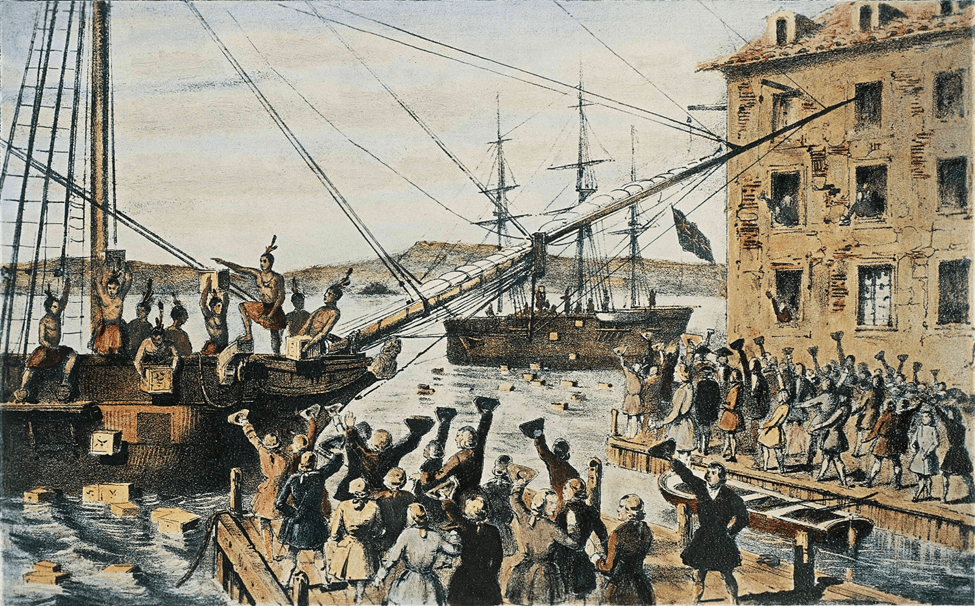
However, instead of the expected submission, this step led to the famous “Boston Tea Party.” At the end of November ships with tea arrived in Boston. The colonists demanded that the cargo be returned to England, but Governor Thomas Hutchinson refused. Then, on December 16, 1773, a group of conspirators from the Sons of Liberty, disguised as Indians, boarded the ships and threw 342 chests of tea into the water, the value of which amounted to about 1 million dollars at today’s exchange rate.

In response, Lord North’s government adopted a series of harsh measures aimed solely at Massachusetts, which was considered the center of the protest movement. The “Intolerable Acts” were passed, which, among other things, closed the port of Boston until the East India Company was compensated for its losses and granted special powers to the executive authorities. Published in Boston on May 10, 1774, these laws provoked an immediate rebuff. The Boston Assembly declared a boycott of British goods, and Samuel Adams called on other colonies to join.
The idea of convening a congress of representatives from all the colonies suited both radicals and conservatives. On September 5, 1774, the First Continental Congress convened in Philadelphia, where 56 delegates from 12 colonies arrived. The Congress split into several factions, reflecting disagreements between North and South. In the end, despite proposals for reconciliation, the Congress adopted the “Petition to the King” and the “Declaration of Rights,” and also approved the creation of the Continental Association and the start of militia mobilization. The delegates were convinced of the inevitability of war but tried not to provide a pretext for it.


However, in London it was decided that the time had come to use force. On January 27, 1775, Secretary of State Lord Dartmouth ordered General Gage in Boston to suppress the uprising, which was bound to lead to war. Anticipating this, on March 20 Patrick Henry called for the mustering of the militia in Virginia, delivering his famous speech with the words: “Give me liberty, or give me death!”
General Gage, having received the order, decided to seize the colonists’ arsenal in Concord to disarm them. On the night of April 18, 1775, he sent a detachment, not knowing that the colonists had already been warned. At dawn on April 19 the British vanguard encountered a detachment of militia at Lexington. A chance shot provoked a skirmish, resulting in the deaths of 8 colonists. The British continued on to Concord, but the depot was empty. On the way back an ambush awaited them, and the British suffered significant losses, losing 65 men killed and 207 wounded. This event went down in history as the Battles of Lexington and Concord.


On the morning of April 20 all approaches to Boston were occupied by an army of militiamen numbering 15,000. George Washington declared: “The once peaceful plains of America will now be either drenched with blood or inhabited by slaves. A sad alternative! But can a virtuous man hesitate in this choice?”
On May 10, 1775, the Second Continental Congress convened in Philadelphia. The delegates were oriented toward war but differed in views. A group led by John Dickinson wanted reconciliation with England, while John Adams and the New England delegates opposed negotiations. As a result, the Congress adopted the “Olive Branch Petition,” which many considered useless but which provided an opportunity to begin negotiations.
On June 15 the Congress decided to turn the Massachusetts militiamen into the Continental Army and appointed George Washington commander-in-chief. On July 6 the document “Declaration of the Causes and Necessity of Taking Up Arms” was adopted, which in fact declared war.


The American army was essentially a militia composed of men aged 16 to 50 who were called up for a short term. This made it ill-suited to fight a regular army, so the Congress formed the Continental Army, although the colonists were opposed to standing troops. However, its numbers never reached the planned 75,000, and the term of service was limited to one year, which led to the need to recruit a new army every year.
The British army in 1775 numbered only 48,000 men, scattered around the world. For war in America this was insufficient. In 1778, when France entered the war, Britain increased the army, but the troops had to be distributed throughout the world, and there were still not enough men in America. To strengthen their forces the British raised Loyalist corps and hired about 29,000 German mercenaries.
The military tactics of both sides were based on classical European linear tactics. The war was primarily an infantry one. Both sides introduced innovations, such as the use of light infantry formations and mixed infantry-cavalry units for reconnaissance.

By the summer of 1775 the British government realized that it was being drawn into a full-scale war. General Gage requested tens of thousands of troops to suppress the uprising. The Secretary at War proposed waging the war solely at sea, seizing ports and conducting raids. However, due to hopes for Loyalist help and a shortage of regular troops, England never managed to develop a single strategy and faced great difficulties from the very beginning of the war.
After the battles of Lexington and Concord, the British troops retreated to Boston, where they were besieged beginning April 20, 1775. American militiamen under Artemas Ward surrounded the city, stretching a line of fortifications for 12 miles. Militias from all the provinces of New England joined him. At the same time the British General Gage concentrated his forces in Boston, fearing an uprising and not daring to occupy the nearby heights.
The Americans needed artillery. A then little-known captain, Benedict Arnold, proposed seizing Fort Ticonderoga to the north, which was known for its guns. On May 10 he successfully carried out his mission, capturing 120 guns, mortars, and ten tons of ammunition, while also solving the problem of transporting them to Boston.
In early June British reinforcements arrived in Boston, increasing the army’s strength to 7,000. Gage decided to break the siege and attack, but the Americans, having learned of his plans, on June 16 occupied and fortified Breed’s Hill on the Charlestown peninsula. The next day the Battle of Bunker Hill began. The Americans repulsed the first attack but were forced to retreat after the second. The victory cost the British dearly; they lost about 1,054 men, which was nearly a quarter of all their forces in North America.


In July 1775 George Washington arrived at Boston and took command of the Continental Army. He was faced with a shortage of gunpowder and the fact that many soldiers’ terms of service were expiring. He was forced to disband the first army and recruit a new one, which by February 1776 numbered 18,000 men. Surrounded on all sides, the British General Howe saw no point in attacking despite the weakness of the American army at the start of winter.
In November 1775 the American bookseller Henry Knox became a colonel and chief of artillery. He proposed to Washington to transport heavy guns from Fort Ticonderoga. In early February 1776 Knox completed his “Noble Train of Artillery,” delivering several dozen guns across 300 miles of wilderness to Boston. On March 2 the Americans occupied the Dorchester Heights, and from their commanding positions they could shell the entire city. The British position became hopeless, and on March 17, 1776, they evacuated from Boston. This event is celebrated in Massachusetts as Evacuation Day.
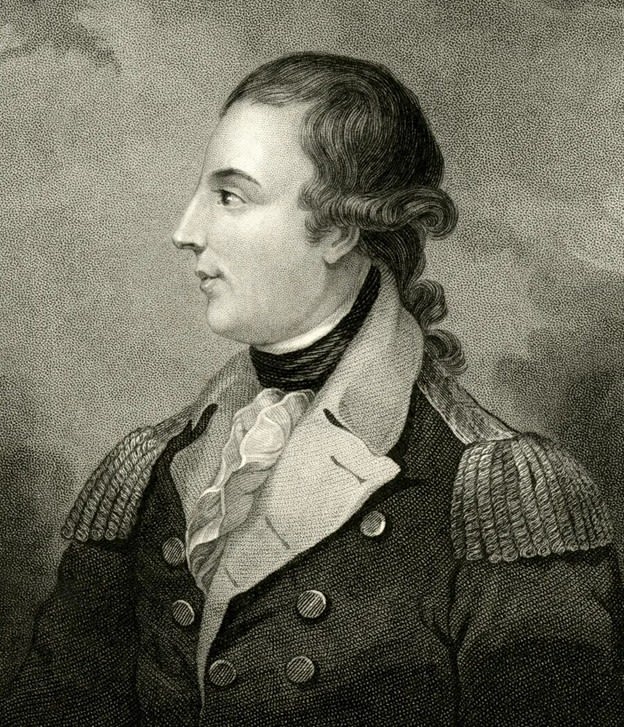
Even during the siege of Boston, the Continental Congress planned an invasion of Canada. On June 27, 1775, General Philip Schuyler received orders to seize part of the Canadian territories, hoping for the support of the French Canadians. Command was entrusted to General Richard Montgomery. At the same time Benedict Arnold convinced Washington to send another detachment to Quebec.

Montgomery, setting out from Fort Ticonderoga, on September 17 besieged Fort St. Jean, and on November 3 took Montreal without a shot. Meanwhile Arnold, after crossing 640 km of forests, approached Quebec with a detachment of 600 men. Uniting with Montgomery, they attempted to storm the city on December 31 but were defeated. Montgomery was killed, and Arnold was wounded. In May 1776 British reinforcements arrived in Canada and completely cleared it of Americans.
In the summer of 1776 the British General Guy Carleton, commander in Canada, began an offensive southward via Lake Champlain. The Americans, realizing the importance of a fleet, built 16 ships over the summer, which under Arnold’s command fought the British squadron on October 11 in the naval battle off Valcour Island. The American fleet was defeated, and Carleton gained a free path south. However, seeing the fortifications of Fort Ticonderoga and the approach of winter, he decided to retreat to Canada.
Simultaneously with events in the north, the British tried to strike in the south. The governor of North Carolina, Josiah Martin, requested assistance, and on January 3, 1776, a detachment under General Cornwallis was sent to Carolina. However, the Loyalists whom Cornwallis was to support were defeated at the Battle of Moore’s Creek Bridge even before the British arrived.
General Henry Clinton, commanding the fleet, decided to attack Charleston. On June 28 the British fleet began bombarding Fort Sullivan, which was defended by South Carolina militiamen. After nine hours of fighting the British withdrew with damage, and the first attack on Charleston failed.
By May 1776, after the failure of the invasion of Canada, it became clear that victory required the help of France, and to achieve that independence had to be proclaimed. Most colonies, realizing that the struggle for autonomy had grown into a struggle for complete independence, supported this idea.
On May 15 the Virginia Assembly instructed its delegates in Congress to propose a formal renunciation of allegiance to Great Britain. On June 7 Richard Henry Lee presented the “Lee Resolution” to Congress, which called for independence, the conclusion of an alliance with foreign powers, and the creation of a confederation. John Adams supported the resolution, but Congress decided to postpone the vote. Instead, a committee of five was created to write a draft Declaration of Independence, whose actual author was Thomas Jefferson.
On July 1 the first vote took place, but not all the colonies voted “yes.” After long debates, on July 2 a second vote was held, and this time the Declaration was adopted unanimously by all twelve colonies.
In a letter to his wife on July 3, John Adams expressed mixed feelings: he realized that the struggle would require tremendous effort, blood, and resources, but he believed in ultimate victory. On July 4 the Congress’s decision was officially proclaimed. On the ninth Washington announced it to the army. On the same day in New York the statue of George III was toppled from its pedestal and melted down into bullets, which became a symbolic act of final rupture.


After the evacuation from Boston, General William Howe, having received instructions and reinforcements, directed his fleet to New York. On July 3, 1776, a British army of more than 25,000 men landed on Staten Island. General Washington, anticipating an attack on New York, shifted his army there, which by summer numbered about 19,000 effectives. The army was poorly trained, undisciplined, and its officers lacked sufficient experience.
The position of the American troops was extremely vulnerable, since they were scattered across the islands. Instead of landing on Manhattan and attacking Washington from the rear, Howe decided to strike frontally. On August 22 the British army landed 22,000 men on Long Island. In the ensuing Battle of Long Island, the largest of that war, the Americans were defeated and retreated, losing about 1,000 men captured. Howe, unwilling to lose men in assaults, decided to besiege their fortifications. However, Washington took advantage of the lack of a favorable wind and, on the night of August 30, managed to ferry the entire army to Manhattan.
After the failure of peace talks, on September 15 General Howe landed 12,000 men on lower Manhattan. He defeated the American militia, but the next day was repulsed at the Battle of Harlem Heights. Unwilling to storm the heights, Howe tried to outflank the enemy but moved extremely slowly, which gave Washington time to withdraw his troops to White Plains. On October 28 the Battle of White Plains took place there, in which the British seized the commanding height but could not deliver a decisive blow.
The situation for the Americans became critical. On November 14 Fort Washington was captured, which became one of the heaviest defeats of the Continental Army. Washington’s army shrank to 5,000 men. Finally, on December 8, Washington retreated beyond the Delaware River. The situation seemed hopeless, and Philadelphia was under threat. General Howe, seeing no point in further pursuit, returned to New York, leaving 3,000 Hessian mercenaries at Trenton.


Upon learning this, Washington made a bold decision. On the evening of December 25 his army secretly crossed the Delaware River and early on December 26 attacked Trenton, defeating the Hessians and taking 900 prisoners. The moral effect of this victory was enormous. Then, on January 3, Washington defeated the British at the Battle of Princeton, after which the British command, realizing the seriousness of the situation, was forced to retreat to New York.
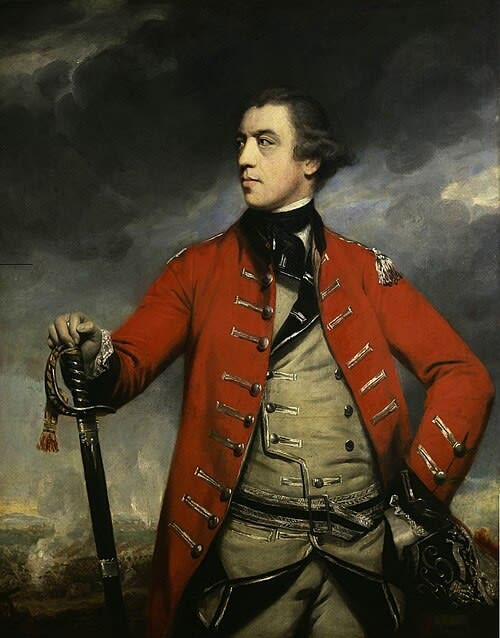
In 1777 the British developed a new plan: General John Burgoyne’s army was to advance from Canada southward and link up with William Howe’s army in New York. This would cut New England off from the other colonies. On July 6 Burgoyne’s army began the siege of Fort Ticonderoga, and the Americans, unable to defend it, abandoned the fortifications. The British won, but suffered serious losses. However, the advance slowed due to a shortage of provisions. On August 16 a detachment of Burgoyne’s forces was defeated at the Battle of Bennington, which cost the British 1,000 men.
At the same time, the auxiliary detachment of St. Leger, moving on Albany, was forced to lift the siege of Fort Stanwix and retreat when his Indian allies left him. These small victories raised American morale.
Despite a shrinking army and a shortage of supplies, Burgoyne continued his advance. On September 13 he crossed the Hudson and encamped near Saratoga. On September 19 the First Battle of Saratoga began. The British managed to hold their position, but they lost 10% of their forces. On October 7, during the Second Battle of Saratoga, the Americans, whose numbers by then had reached 11,000, delivered a decisive blow. They drove the British back and captured one of their fortifications. Burgoyne found himself completely encircled. After long negotiations, on October 17 he agreed to capitulate. Six thousand British soldiers were taken prisoner.
The Battle of Saratoga became the turning point of the war. Britain lost an entire army. American morale rose, and, more importantly, this victory convinced France that the Americans were capable of fighting and pushed it to conclude an alliance with them.

In parallel with Burgoyne’s advance, Howe from New York began his campaign to capture Philadelphia. He tried to lure Washington from his fortified position on the Middlebrook Heights, but failed. At the end of July Howe embarked his army on ships and put to sea, forcing Washington to guess where he would go. Only on August 25, 1777, did the British land in the Chesapeake Bay and begin their advance on Philadelphia.
On September 11 at the Battle of Brandywine the British managed to outflank the American wing and defeat it, but the Continental Army, though beaten, was not destroyed. On September 26 the British entered Philadelphia. Washington did not give up attempts to strike back. On October 4 he attacked Germantown, but due to confusion and friendly fire the attack failed.
Despite the fact that the Americans failed to retake Philadelphia, their defeat was incomplete, and hostilities continued. On December 5 the British attacked American positions at White Marsh, but the battle ended in a draw. With the onset of cold and snowfall, both armies ceased active operations.
At the end of December 1777, the Continental Army, exhausted by the autumn battles, went into winter quarters at Valley Forge on the banks of the Schuylkill River. The conditions were appalling. The soldiers lacked clothing and blankets, the supply system had collapsed, and they had to live in tents that poorly protected from the elements, and then in hastily built log huts. Due to unsanitary conditions smallpox and typhus broke out in the camp, which, combined with hunger and desertion, reduced the army to five to six thousand men, of whom only half were fit for service. These soldiers had combat experience, but they catastrophically lacked knowledge of tactics and maneuvering large formations.
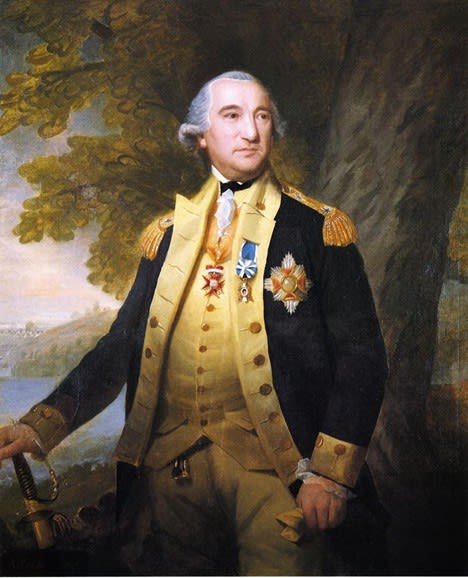
In February a Prussian officer, Baron von Steuben, sent from Paris by Benjamin Franklin, arrived in the camp. He was shocked by the state of the army. “As for military discipline,” he wrote, “I can say with certainty that no such thing existed there.” Washington appointed him inspector, and Steuben, taking the Prussian military regulations as a basis, personally began to train the soldiers in drill. Thanks to his efforts, by June 1778 the Continental Army had become disciplined and more battle-ready, which played a decisive role in the further course of the war.

Burgoyne’s capitulation at Saratoga became not only a military but also a powerful moral blow to Britain. This event led to a surge of patriotism in England; many cities raised and financed several infantry regiments. However, the main consequence of the victory at Saratoga was France’s entry into the war. On December 4, 1777, Benjamin Franklin learned of the victory, and already on December 17 the French Foreign Minister, Count Vergennes, received the king’s consent to negotiations with the American delegation. On February 6, 1778, the Treaty of Alliance and the Treaty of Amity and Commerce were signed, which became the first international recognition of the United States. In response to this, on March 17 England declared war on France.
France’s entry into the war forced Britain to reconsider its strategy. With its troops scattered around the world, it became obvious that in North America it was necessary to switch to the defensive. It was decided to evacuate Philadelphia and shift the focus to the southern colonies, where they hoped to gain Loyalist support.
General William Howe, whose resignation was accepted, handed command of the army to General Henry Clinton. On June 18, 1778, a British army of about 15,000 left Philadelphia and began retreating overland. Washington, despite disagreements among his generals, decided to pursue the enemy.
On the morning of June 28, 1778, the Battle of Monmouth took place. The vanguard of the American army under General Charles Lee met the British and began a disorderly retreat. Washington, arriving on the field, took command, halted the retreat, and organized the defense. Clinton withdrew, and the Americans, although they did not win a decisive victory, were able to present the battle as their triumph. This battle was the last major battle in the North. It also helped Washington strengthen his reputation and overcome political opponents.


After Monmouth, Washington directed his army toward New York to support the French squadron. However, due to poor coordination, the joint attack on Newport failed. Throughout 1779 there were no major battles in the North. The British focused on raids and sabotage, and the Americans on defense. In the summer of 1779 American forces under General Sullivan conducted the “Sullivan Expedition” against the Iroquois Indians and their Loyalist allies, destroying 40 villages but failing to put an end to their raids.
The winter of 1779–1780, which the Continental Army spent at Morristown, was the harshest of the entire war. Due to severe frosts and a shortage of food, the army again found itself on the verge of collapse. At this time France decided to send a large land force to America under General Rochambeau. On July 10, 1780, the French fleet arrived at Newport, but Washington and Rochambeau failed to agree on a joint attack on New York.

Among other things, it was at this time that the conspiracy of Benedict Arnold was uncovered; commanding the fortifications of West Point, he had been passing secret information to the British. His courier, Major John André, was caught red-handed, and Arnold, upon learning of this, managed to escape to the British. This incident shocked Washington but did not undermine his resolve.
Hostilities were carried out not only in the North but also on the western frontiers of the colonies. In 1778 a detachment under George Clark conducted the Illinois campaign, capturing Kaskaskia and Vincennes. After a British detachment retook Vincennes, Clark made a forced march through forests and swamps and on February 24, 1779, captured Fort Sackville again. This victory ensured American control over the Illinois Territory.
Spain also joined the war, declaring war on Britain in June 1779. The Spanish governor Bernardo de Gálvez began an offensive against British possessions. On March 14, 1780, he captured Mobile, and then besieged and took the major British fortress of Pensacola. These actions ended British rule in West Florida, which also helped the Americans.
I have processed all parts of your text, turning them into a single, coherent, and detailed account of the events of the American War of Independence. If you have other requests, I am always ready to help.
Confidence reigned in the British command that in the South they had many supporters and that few forces would be required to subdue them. Therefore, in November 1778 General Henry Clinton sent 3,500 men to Georgia under Archibald Campbell. On December 29 the British landed in Georgia and at once captured Savannah, and then Augusta, where Loyalists began to gather. Despite a series of victories, the British still failed to fully subdue Georgia.
In the summer of 1779, a French fleet arrived off the coast of Georgia and cut off the British garrison of Savannah from New York. The Americans and the French besieged Savannah, but after an unsuccessful assault in October were forced to withdraw.
In winter the French fleet sailed south, which allowed Clinton to transfer a large contingent to the South. On January 30, 1780, 8,500 British soldiers landed at Savannah and from there set out to besiege Charleston in South Carolina. The American General Lincoln kept his army in the city. In May, when all routes of retreat were cut off, Lincoln capitulated. More than 5,000 men were taken prisoner. All of South Carolina was left without an army to resist.
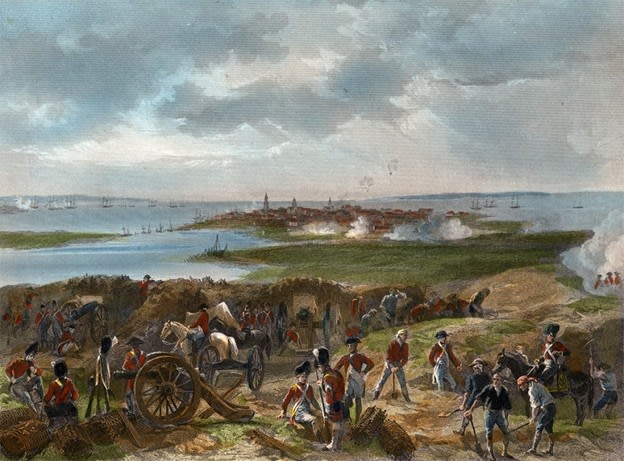

After the capture of Charleston, the resistance was led by General Horatio Gates. On August 16, 1780, his army was utterly defeated by the British at the Battle of Camden, and two days later the British cavalryman Banastre Tarleton routed another American detachment. His cruelty in this battle earned him the nickname “Bloody Tarleton.” The destruction of American detachments, instead of breaking resistance, on the contrary aroused a thirst for revenge among the colonists.
General Cornwallis, who had taken command in the South, decided to invade North Carolina. On October 7 his Loyalist detachment was destroyed at the Battle of Kings Mountain. Having lost his best commander, Cornwallis was forced to retreat.

Command of the American army in the South was taken by Nathanael Greene. On January 17, 1781, his detachment, led by General Morgan, utterly defeated Tarleton’s cavalry at the Battle of Cowpens. After this Cornwallis began a determined pursuit of Greene, but the latter managed to get beyond the Dan River. In March Greene returned, and on March 15 the Battle of Guilford Court House took place. Greene lost the battle, but Cornwallis lost nearly a quarter of his army and was forced to retreat.
After Guilford Court House, Greene began a campaign to liberate South Carolina, which by that time was held only by Loyalists in isolated forts. Within a few months he regained control over most of the state. On September 8 the Battle of Eutaw Springs took place, which became the bloodiest in the South. After it the English held only Charleston and Savannah.
On the international stage, on March 8, 1780, the Russian Empress Catherine II declared the “Declaration of Armed Neutrality,” which protected the right of neutral countries to trade with belligerents. This caused irritation in Britain, which feared that it would lead to the entry of other countries into the war. In December 1780 Britain declared war on Holland, seizing on a pretext but fearing that Holland would join the coalition of neutral states. Catherine II, despite England’s attempts to draw her into an alliance, refused, and armed neutrality continued to put pressure on Britain.
Meanwhile, hostilities shifted to Virginia. On January 5, 1781, a British detachment under Benedict Arnold, who had gone over to the English side, captured Richmond. Washington sent a detachment of Lafayette to Virginia, but he lacked the forces for a decisive battle.
On May 20 General Cornwallis arrived in Virginia with an army, increasing the number of British troops to 7,200. For several months Cornwallis pursued Lafayette, who skillfully avoided a general engagement. By summer Cornwallis retreated to the coast, and in August he received orders to occupy Yorktown and establish a base for the fleet there.
This proved a fatal mistake. Washington, learning that Admiral de Grasse’s French fleet would arrive in the Chesapeake Bay, immediately decided to seize the moment. He took part of his army and joined with the French troops of General Rochambeau. On September 5, in the Battle of the Chesapeake, the French fleet won a victory over the British and cut Cornwallis off from the sea.
On September 28 American and French troops began the siege of Yorktown. On October 14 they attacked and captured two key British redoubts. After Cornwallis’s plan to break out of the encirclement failed, on October 17 he requested negotiations for capitulation. On October 19, 1781, the British army, numbering 7,247 men, laid down its arms. Cornwallis avoided taking part in the ceremony.


On November 25 news of the capitulation reached London. Lord North, hearing it, exclaimed: “O God! All is lost!” The surrender of Cornwallis became the de facto end of the war. As the historian John Fortescue wrote, the history of the American War of Independence ended at Yorktown.
Despite the fact that the king and the government decided to continue the war, on February 27, 1782, Parliament ordered the cessation of all offensive operations in America, and on March 22 Lord North resigned. The French and Spanish continued to win victories, capturing the islands of Sint Eustatius, Saint Martin, and Saint Kitts. They were preparing to capture Jamaica, but on April 9, 1782, at the Battle of the Saintes, the largest naval battle of the 18th century, the French fleet was defeated and Jamaica was saved.


On March 4, 1782, the British Parliament officially resolved to begin peace negotiations, declaring enemies those who would advise continuing the war on the American continent. This decision was humiliating but necessary due to failures, financial losses, and the poor state of the fleet.
During the negotiations in Paris, disagreements arose between the American and French diplomats. The French minister Vergennes had his own plans, which could restrict the territorial and economic interests of the United States. Learning of this, the American diplomats John Jay and John Adams entered into separate negotiations with Britain, which led to the signing of a preliminary agreement on November 30, 1782. Under the terms of this agreement, Britain ceded to the United States all lands up to the Mississippi. Vergennes expressed his displeasure, but this did not affect relations between the United States and France. On January 20, 1783, England signed an armistice with France and Spain, which, unlike the United States, received very little from the war.
The concluded peace caused indignation in Britain, and the Shelburne government that had signed the treaty was forced to resign. Nevertheless, on September 3, 1783, the treaty was signed on the very same terms.

George Washington did not believe that the war was truly over until the British surrendered Charleston in December 1782. In January 1783 unrest arose among the army’s officers due to fears that they would not be paid arrears, but Congress met them halfway and guaranteed them lifetime pay. In mid-April the peace treaty was ratified, and the war officially ended.
The Treaty of Paris was a defeat for Great Britain, which, however, did not abandon its imperial ambitions but merely switched its attention to India. Defeat in the war pushed England to reform its army and navy, which ultimately helped it in subsequent wars. France, despite victory, found itself on the verge of bankruptcy, which became one of the causes of the French Revolution, which, by general opinion, was influenced by the American one.
The United States received independence, freedom of trade, and vast lands for development. But they still had to unite 13 independent states with differing interests. The question of the powers of the states and the federal center, especially on the issue of slavery, ultimately led to the Civil War in 1861.
Losses in the war were significant. According to historians’ estimates, the American army lost about 25,000 men, which amounted to 1% of the entire population. The total combat losses of all parties to the conflict amounted to approximately 40,000 people.
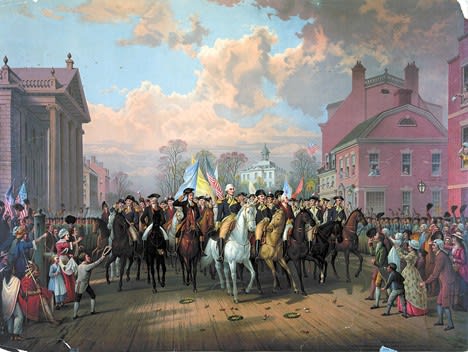
Finally, on the morning of November 25, 1783, the British left New York, and Washington entered the city. On December 22 in Annapolis he solemnly resigned his powers as commander-in-chief, completing his long and difficult journey.