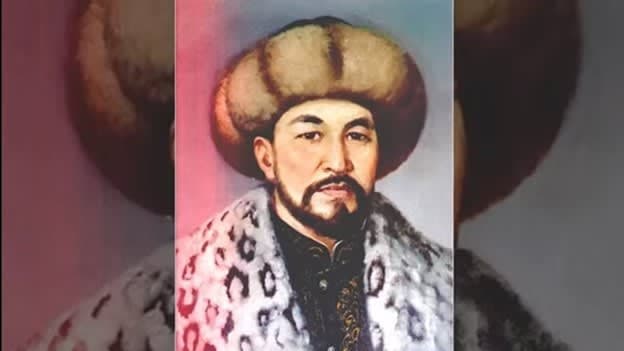

Alimbek was born in 1799 in the Alay Valley to the influential and wealthy Asan-biy, a hereditary aristocrat from the ancient Bargy tribe. Alimbek received a good education and from a young age showed intellect, foresight, and leadership.
At twenty-seven he was invited into the service of the Kokand khan Madali Khan, and at thirty-one he was granted the title datka (“just ruler”). Soon afterward, at thirty-two, he was appointed governor of the Andijan vilayet. The rulers of Kokand needed a powerful figure who could secure the Alay route of the Great Silk Road and access to Chinese markets. Alimbek Datka, who enjoyed enormous authority among Kyrgyz, Uzbeks, and Kipchaks alike, proved to be exactly such a man.

In 1844 Alimbek Datka led the Osh uprising of the Kyrgyz in the Alay against the Kipchak ruler Musulmanqul, but it was suppressed. At the same time, in southern Kyrgyzstan he launched an anti-Qing rising, supporting Khoja-Töre in his bid for the Kashgar throne; the revolt failed due to the numerical superiority of Qing forces.
The most striking event in Alimbek’s career was elevating Malla Khan to the Kokand throne in 1858. Having fled to Alimbek, Malla Khan gained his backing as Alimbek assembled a coalition of Kyrgyz and Fergana Kipchaks. Their combined army defeated Khudoyar Khan’s forces at the Battle of Samanchi, and Malla Khan became the new ruler of Kokand. For his services, Alimbek Datka received the Andijan vilayet and was made the khanate’s first vizier, concentrating enormous power in his hands. He pursued a de facto independent policy, and his agreement with Kokand even stipulated his right to administer the Alay autonomously.

At this time, as the noted Kazakh scholar Chokan Valikhanov wrote, the influence of the Kyrgyz nobility in the Kokand Khanate became extraordinarily great, since many key posts were held by members of Kyrgyz tribes.
In 1860 a Kokand force under Alimbek Datka and the governor of Tashkent, Kanaat Shah, marched against troops of the Russian Empire, which had invaded the northern Kyrgyz lands and destroyed the fortresses of Tokmak and Pishpek. During the Battle of Uzun-Ağach a dispute broke out among the Kokand commanders over overall command. Insulted, Alimbek Datka withdrew his troops, which led to Kokand’s defeat.

After the battle, Kanaat Shah slandered Alimbek before Malla Khan, accusing him of treason. Learning of the plot, Alimbek rose in revolt, seeking to create an independent Kyrgyz state. His uprising was unique in that it aimed not at replacing the ruler or gaining privileges, but at full secession from Kokand.
On the night of February 24, 1862, Alimbek Datka, Shadman-khoja, and other conspirators killed Malla Khan and placed the fifteen-year-old Shahmurad on the throne. A diarchy ensued, however, since Khudoyar was also proclaimed khan in Tashkent; a struggle for power flared among Shahmurad’s supporters. In the course of that struggle when Shadman-khoja and his followers moved against their rivals—they decided to eliminate Alimbek Datka, who remained in Kokand. He was killed, ending his ambitions.
Alimbek Datka was not only a military leader and politician but also an active builder. He constructed several bridges over the Ak-Buura River to unite the populations and economies of its two banks, and he erected mills, irrigation canals, mosques, and madrasas. His efforts to strengthen the Alay Valley and its infrastructure left a notable mark on the region’s history. The killing of Alimbek Datka like the earlier death of another Kyrgyz leader of the northern tribes, Ormon Khan, in 1854 was among the reasons for the total collapse of the Kyrgyz Khanate and the subsequent incorporation of these lands into the Russian Empire.


