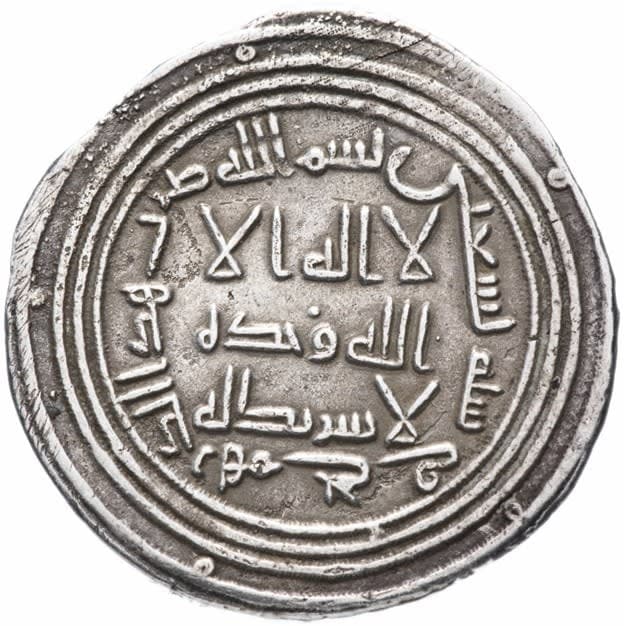

Al-Walīd was born around 674 in the sacred city of Medina, during the reign of the dynasty’s founder, Muʿāwiya I. His lineage was impeccable: his father belonged to the influential line of Abū al-ʿĀṣ, while his mother, Wallāda bint al-ʿAbbās, came from the ancient and noble tribe of Banū ʿAbs. The prince’s early years coincided with a period of great upheaval. In 684, when Umayyad power in the Ḥijāz collapsed under the pressure of Ibn al-Zubayr, al-Walīd’s family was expelled from Medina and found refuge in Syria.
There, his grandfather Marwān I, and later his father ʿAbd al-Malik, began a long process of reconquest. Al-Walīd grew up in the atmosphere of a military camp and rigid centralization. Even as heir, he hardened his character in annual campaigns against Byzantium (696–699), raiding Malatya and other frontier fortresses. He also showed an interest in construction and securing the rear: in 700–701, under his patronage, the oasis of Qaṣr Burquʿ in the Syrian Desert was expanded—an important outpost on the route to the holy cities of the Ḥijāz.

The path to power was not smooth. ʿAbd al-Malik sought to pass the throne to his son over the head of his brother ʿAbd al-ʿAzīz, governor of Egypt. Only the latter’s sudden death in 705 removed this obstacle. On October 9, 705, after his father’s death, al-Walīd officially ascended the throne.
Contemporaries described him as a tall, dark-skinned man with a characteristic upturned nose. Notably, contrary to his father’s expectations, the caliph did not possess perfect command of classical Arabic and often made mistakes in speech. This did not prevent him from being a fanatical guardian of the faith: he demanded that all those around him know the Qur’an by heart, turning mastery of the sacred text into a mandatory feature of court life.
Under al-Walīd I, the expansion of the caliphate received a colossal impulse. The caliph wisely retained in office the ruthless but effective “viceroy” of the East, al-Ḥajjāj ibn Yūsuf, granting him complete freedom of action.
At al-Ḥajjāj’s direction, the commander Qutayba ibn Muslim accomplished the seemingly impossible between 705 and 715: he crossed the Oxus and subdued the city-states of Central Asia. One after another fell Bukhara (709), Khwarazm and Samarkand (712), and in 713 his troops reached the Fergana Valley. At the same time in the south, al-Ḥajjāj’s nephew, the young Muḥammad ibn al-Qāsim, conquered Sind, opening a gateway to South Asia.
On the western frontiers, the governor of Ifrīqiya, Mūsā ibn Nuṣayr, finally subdued the Berber tribes of the Maghreb. In 711 his freedman Ṭāriq ibn Ziyād crossed the strait that now bears his name (Gibraltar) and invaded the Visigothic kingdom of Spain. After decisive victories and the arrival of reinforcements led by Mūsā himself, by 716 almost the entire Iberian Peninsula had come under the caliph’s authority. The immense spoils of war that poured into Damascus were comparable to the booty of the age of the great Caliph ʿUmar.
On the Byzantine front, the caliph’s half-brother Maslama ibn ʿAbd al-Malik was active. Although the great siege of Constantinople occurred after al-Walīd’s death, extensive preparations for this crushing blow were made during his reign. In 708 the key fortress of Tyana was captured, and by 714 Arab detachments were already raiding deep into Anatolia, reaching Ankara.


Within the state, al-Walīd continued his father’s policy of the “Arabization” of the empire. In 705–706 Arabic definitively replaced Greek and Coptic in the Egyptian chanceries. The caliph balanced between two powerful tribal factions the Qaysites (northerners) and the Yemenites (southerners) preventing either from monopolizing power. Al-Ḥajjāj in Iraq and Qurra ibn Sharīk in Egypt imposed strict tax collection, enabling the financing of ambitious state programs.
Al-Walīd entered history as one of the most socially oriented rulers. Using the treasures of conquest, he built roads, dug wells, and constructed roadside stations for travelers. He introduced state stipends for the poor and the disabled (primarily in Syria). According to some reports, he founded in Damascus in 707 the first bīmāristān (hospital) in the Islamic world, or a leprosarium for the isolation and care of those afflicted with leprosy. In 714 he founded the fortress-city of Anjar, which became a symbol of Umayyad urban planning.
Al-Walīd’s greatest legacy was his mosques. He understood that architecture was the best instrument for proclaiming the grandeur of Islam.
The Umayyad Mosque in Damascus, built on the site of the Cathedral of John the Baptist between 705 and 711, became an architectural marvel. A quarter of entire armies’ pay was spent on its decoration, and its walls were adorned with magnificent golden mosaics.

Al-Aqṣā Mosque in Jerusalem: al-Walīd completed or significantly expanded his father’s project on the Temple Mount, employing the finest craftsmen from Egypt.

The Prophet’s Mosque in Medina: in 706, by order of the caliph, his cousin ʿUmar ibn ʿAbd al-ʿAzīz began a grand reconstruction. The old dwellings of the Prophet’s wives were demolished, and the Prophet’s grave was incorporated into the mosque—provoking protests among local circles, which al-Walīd suppressed decisively.
Al-Walīd’s final years were overshadowed by an attempt to alter the order of succession. He wished to make his son ʿAbd al-ʿAzīz caliph, sidelining his brother Sulaymān. This created deep tension within the dynasty.
On February 23, 715, al-Walīd I died of illness at his winter residence of Dayr Murrān on the outskirts of Damascus. He was buried in the cemetery of Bāb al-Ṣaghīr. Despite his efforts, the throne passed to Sulaymān, who immediately dismissed most of his predecessor’s close associates.
Nevertheless, during his ten-year reign, al-Walīd I transformed the Caliphate into a world empire whose cultural and territorial foundation remained firm for many decades.


