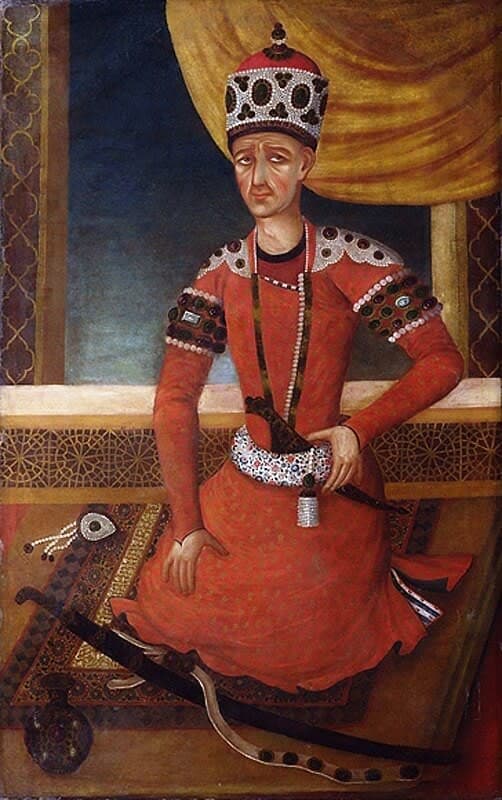

Agha Mohammad Khan was born around 1742 in Astarabad, in the very heart of the lands of the Turkmen Qovanlu clan. He was the eldest son of Mohammad Hasan Khan Qajar, a powerful chieftain whose lineage, according to Agha Mohammad himself, went back to great Turkic houses, equal in glory to the rulers of Turan, Hindustan, and Russia. The fate of the young prince changed radically in 1747, after the death of Nader Shah.
In the chaos that engulfed the country, Agha Mohammad’s father rose against the new ruler Ali Adil Shah. The revolt failed, and the six-year-old boy was taken prisoner. Adil Shah, wishing to prevent childbearing in the dangerous line of rivals, ordered the child to be castrated. This physical mutilation became a source of endless mockery—behind his back he was called “Akhta Khan” (Eunuch Khan), but it was precisely this that gave rise in him to that boundless cruelty and cold rationality that would later make all of Asia tremble.

After his father’s death in 1759, Agha Mohammad and his brother Hossein Qoli Khan were forced to seek refuge among the Turkmen Yomuts. After a series of unsuccessful attempts to regain Astarabad, Agha Mohammad was seized and sent as a hostage to Tehran, and then to Shiraz—the brilliant capital of Karim Khan Zand.

In Shiraz, the captive proved himself an outstanding political thinker. Karim Khan, struck by his intellect, made Agha Mohammad his adviser, calling him “Piran-i-Vizeh”—in honor of the wise vizier from the epic Shahnameh. For almost twenty years he lived in a “golden cage,” studying the mechanisms of power and waiting for his hour. The hour struck on 1 March 1779, when his aunt Khadija Begum informed him of Karim Khan’s death. Agha Mohammad, losing not a minute, fled Shiraz under the pretext of hunting and rushed north.
Returning to his native lands, Agha Mohammad faced the need not only to fight the Zands, but also to subdue his own brothers—Reza Qoli and Mortaza Qoli. The latter did not wish to recognize the rule of a eunuch. Mazandaran became an arena of brutal internecine strife. Agha Mohammad proved himself a master of diplomacy and terror: at times he formed alliances with the Develu clan (the old rivals of his family), at times he mercilessly smashed the armies of his relatives.

By 1781, he had established control over the key cities of the Caspian coast: Hecatompylos, Semnan, and Damghan. His authority grew thanks to the skillful use of the discontent of local khans, whom the Zands subjected to repression. Agha Mohammad practiced distributing seized lands to his supporters, giving preference to his fellow Qajars, which allowed him to create a loyal military elite.
In 1784, Qajar power faced its most serious threat. The Zand ruler Ali Murad Shah sent a colossal army of 60,000 men into Mazandaran. Agha Mohammad, abandoned by almost all his allies, shut himself up in Astarabad. He applied a scorched-earth tactic, devastating the surroundings of the city in order to deprive the enemy of provisions, and organized daring sorties.
The siege ended in catastrophe for the Zands. Ali Murad’s army, exhausted by hunger and partisan attacks, was scattered. The Zand commander was seized by Yomut allies and brutally killed on Qajar’s orders. By November 1784, Mazandaran had been completely cleared of the invaders. The death of Ali Murad Shah in February 1785 opened the road to Tehran for Agha Mohammad.
Agha Mohammad’s first appearance beneath the walls of Tehran was met with refusal: the townspeople declared that they would open the gates only to the recognized ruler of Persia. This forced him to immediately move against Jafar Shah Zand. In May 1785, Agha Mohammad captured Isfahan, subjecting the city to a devastation that contemporaries compared to the Afghan invasion.

On 12 March 1786, a historic event took place: Agha Mohammad Khan officially made Tehran his capital. The choice of this city, then still small, was strategic genius—it lay close to the Qajars’ ancestral lands and made it possible to react quickly to events in the Caucasus and Azerbaijan.
The following years turned into an endless pursuit of Jafar Shah. Agha Mohammad methodically subdued province after province. In 1782–1786 he seized Gilan, taking possession of the legendary treasures of Hedayat-Ullah Khan. His power spread to Hamadan, Qom, and Kashan.
In 1788, Agha Mohammad came right up to Shiraz. Despite the fact that the city was strongly fortified, he managed to impose his will on the Qashqai tribes and force the local rulers to recognize his suzerainty. The death of Jafar Shah in 1789 and the civil war among the Zands that followed finally cleared his path to the throne.
The year 1789 became the official date for the beginning of Agha Mohammad Qajar’s rule as the de facto sovereign of Persia. It was then that he appointed as his heir his nephew Baba Khan (the future Fath Ali Shah), laying the foundation of a dynasty that would rule the country for more than a century. He had not yet been crowned officially, but all of Iran already knew that the era of chaos was over: the time of the Iron Eunuch had arrived.

After fleeing Shiraz, Agha Mohammad’s main goal became the final crushing of the Zand dynasty. His chief opponent was Lotf Ali Shah — a young, brave, and charismatic leader who became the last hero of a fading house.

Agha Mohammad twice approached the walls of the Zands’ capital. The sieges were exhausting, but the Qajar ruler understood: Shiraz was the enemy’s heart.
To secure his rear, Agha Mohammad spared not even kin. He ordered the execution of his brother Jafar Qoli Khan, seeing in him a dangerous rival. His logic was simple: it was better to be a tyrant without brothers than a corpse in a disputing dynasty.
The turning point was a coup in Shiraz organized by the governor Haji Ibrahim Kalantar in 1791. While Lotf Ali was fighting in the field, Kalantar shut the city gates in his face and offered loyalty to the Qajar. This betrayal decided the Zands’ fate.

Lotf Ali Shah, deprived of his capital, retreated to Kerman. In 1794, Agha Mohammad’s army besieged the city. After the fall of Kerman, one of the bloodiest reprisals in the history of the East followed: the fate of Lotf Ali—the last Zand—was sealed in Bam; he was betrayed, captured, and blinded. Before his death in Tehran, he was subjected to monstrous humiliations.
Agha Mohammad accused the inhabitants of Kerman of supporting the enemy. By his order, 20,000 men were blinded, and their eyes were brought to the shah on a platter. A pyramid was built from severed heads, and women and children were given into slavery.
For Agha Mohammad, Georgia was not a foreign state but a rebellious province. In 1795, he demanded that King Erekle II renounce the Treaty of Georgievsk with Russia and return under Persia’s suzerainty. Receiving a refusal, the shah marched into the Caucasus with a 70,000-strong army.
On the way, the shah subdued the Karabakh, Ganja, and Erivan khanates.
In September 1795, despite the Georgians’ desperate resistance, the Qajar army burst into the capital. Tbilisi was turned into ruins, the population was slaughtered, and about 15,000 people were driven off into slavery. Russia, obliged by treaty to protect Georgia, did not send help at that moment.
In the spring of 1796, on the Mughan steppe, Agha Mohammad was officially proclaimed shah. He emphasized his succession from the Safavids by girding himself with the sword of Ismail I Safavi.
Immediately after this, he headed to Khorasan to seize the remnants of Nader Shah’s treasures from his blind grandson Shahrokh. When Shahrokh swore that there were no treasures, Agha Mohammad used a refined torture: molten lead was poured onto Shahrokh’s shaved head, forcing him to reveal the hiding places of the jewels. Exhausted by torture, Nader’s descendant died on the road to Mazandaran.
Agha Mohammad’s victorious march ended suddenly. In 1797, during his second campaign in the Caucasus, the shah took Shusha. Three days after the triumph, a fatal quarrel broke out between two servants. Enraged, the shah ordered them to be executed on Saturday. The servants, realizing they had nothing to lose, entered his tent at night and stabbed the sleeping shah to death.
Agha Mohammad Shah was a man of contradictions. A eunuch who had suffered deep trauma in childhood, he sublimated his pain into unlimited power and the accumulation of wealth.
Agha Mohammad Qajar left his successor, Fath Ali Shah, a pacified and unified country. He is often compared with Genghis Khan or Tamerlane—he was the last of the great conquerors of Asia who ruled from the saddle. Despite rivers of blood, it was precisely he who became the “original architect” of Iran within its modern borders.


