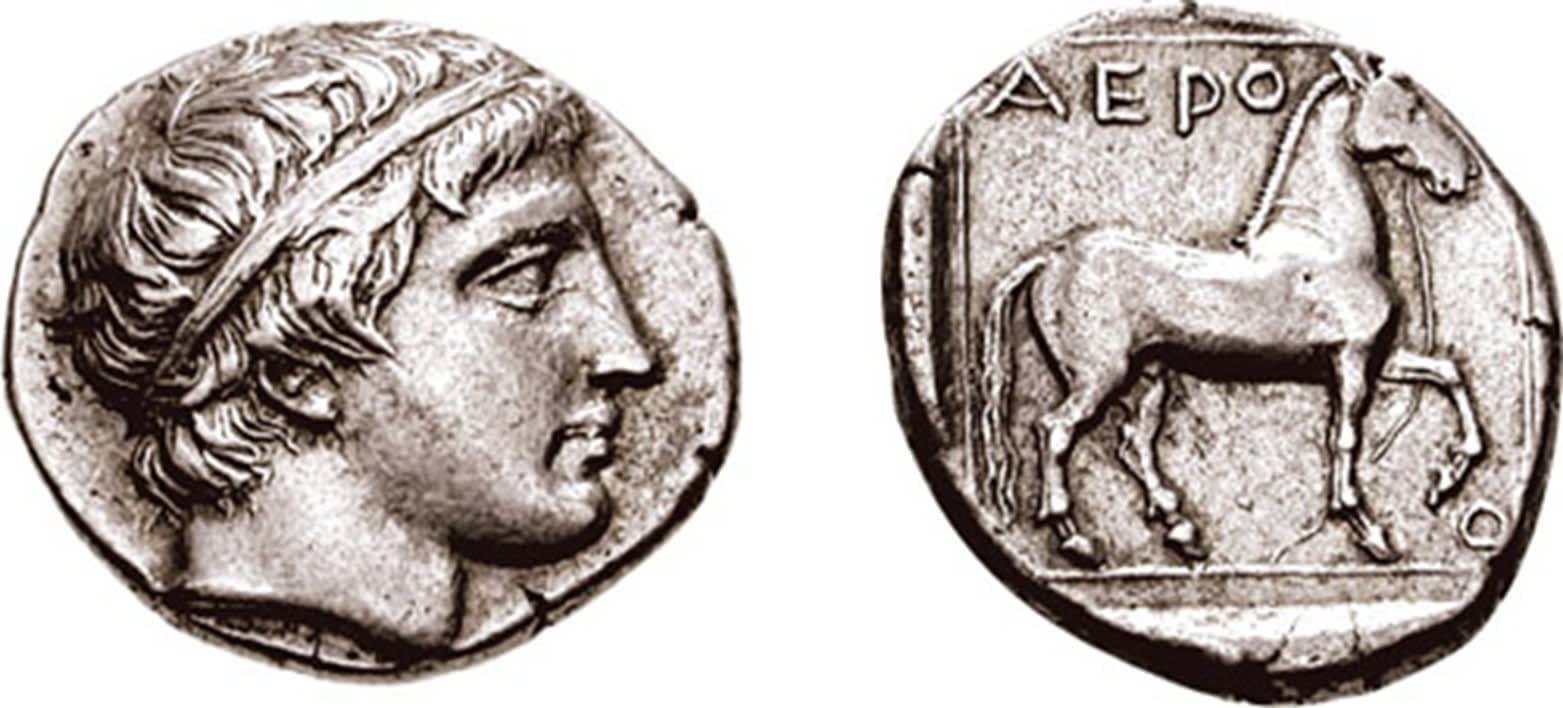
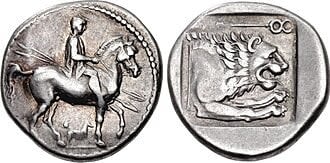
Aeropus was a full-blooded member of the Argead dynasty. This is strongly suggested by the fact that, after the death of Archelaus, he was able to assume the highest position of regent for the underage heir Orestes. An outsider from a rebellious province would hardly have received such recognition from the Macedonian nobility.
Indirect evidence of his high status even before these events can be found in his participation in the signing of an important peace treaty between Macedonia and Athens in 415 BC. Most scholars agree that Aeropus was a son of Perdiccas II and was therefore the brother — most likely the half-brother — of the murdered Archelaus.
The transfer of power to Aeropus did not happen immediately.
The philosopher Plato preserved a grim detail from those turbulent days. Immediately after the death of Archelaus in 399 BC, power was seized by Crateuas, one of the king’s assassins. His “reign,” however, lasted only three or four days before he himself was killed.
In the resulting power vacuum, Aeropus assumed the role of regent and guardian of the boy-king Orestes, the legitimate heir to the throne.
The regency lasted several years, until the young Orestes died.
Whether he died naturally from illness or, as hostile rumors and ancient chroniclers later claimed, was quietly removed by his ambitious guardian will probably remain a mystery forever.
Whatever the truth, with the final obstacle removed, Aeropus placed the royal diadem upon his own head.
There is even an interesting hypothesis that, upon becoming king, he adopted the throne name “Archelaus” in order to emphasize the legitimacy and continuity of his rule.
After ascending the throne, Aeropus II inherited a difficult political situation.
Shortly before his death, his predecessor Archelaus had brilliantly extended Macedonian influence into Thessaly, making Larissa an important base of operations.
Aeropus, however, judged the situation differently.
As the historian K. J. Beloch observed, the new ruler was too preoccupied with maintaining his authority within Macedonia itself. The threat of war against the Greek city-states for control of Thessaly seemed an unacceptable luxury.
He therefore made a difficult but pragmatic decision: Macedonian forces were recalled home, and the kingdom’s imperial ambitions in the south were abandoned.
Yet Aeropus was unable to remain outside the great political struggles of Greece.
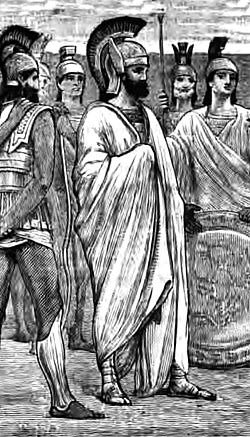
Polyaenus preserved a fascinating episode describing his confrontation with the famous Spartan king Agesilaus II.
Between 396 and 394 BC, Agesilaus had been campaigning successfully against the Persians in Asia Minor. But the outbreak of the Corinthian War in Greece — a rebellion of several major city-states against Spartan hegemony — forced him to return home in haste.
The Spartan army’s route led directly through hostile Thessaly and Macedonia.
Aeropus decided to take advantage of the situation.
He sided with the anti-Spartan coalition and attempted to block the mountain passes, hoping to trap and destroy Agesilaus’s army.
Agesilaus, however, managed to outmaneuver the Macedonian defenses. Aeropus was left with little choice but to back down and conclude some form of agreement with Sparta guaranteeing the army’s safe passage.
The precise terms of this arrangement have been lost to history.
Historians date this dramatic confrontation to the summer of 394 BC. Shortly afterward, on 14 August 394 BC, Agesilaus’s army witnessed a total solar eclipse, providing modern scholars with an exceptionally precise chronological marker.
The reign of Aeropus II ended as suddenly as it had begun.
Unlike many of his predecessors and successors, he escaped the assassin’s blade and died of natural causes after suffering from a severe illness.
Most scholars date his death to 394 BC.
Aeropus’s death removed the final barrier holding back dynastic chaos.
The kingdom collapsed into a bloody civil struggle. Within the space of a single year, the Macedonian throne became the prize in an extraordinary succession of rival claimants.
First, Amyntas II was proclaimed king, but he was soon killed by a man named Derdas.
Power then passed to Aeropus’s legitimate son, Pausanias.
Yet he too proved unable to retain the heavy crown of the Argeads. He was rapidly overthrown — or, according to another reconstruction of events, killed immediately after Aeropus’s death, with Amyntas II never truly ruling in between — by another ambitious relative, Amyntas III.
Thus ended the age of Aeropus II.
He was a man who had survived the bloodshed following the death of the great Archelaus, consolidated royal authority, kept the kingdom from being drawn into major external wars, and even dared to challenge Sparta itself.
Yet he left behind a state that would have to endure years of brutal instability before Philip II finally ascended the throne and permanently changed the course of world history.


