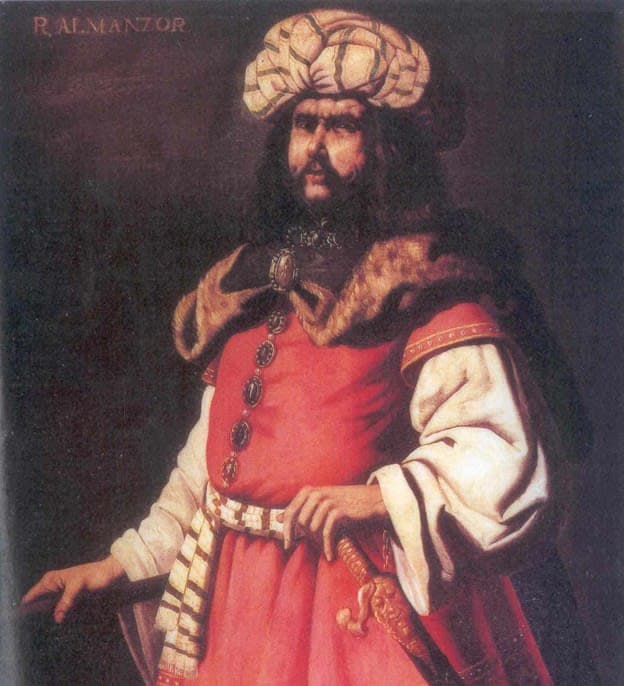

The story of Abu Jaʿfar ʿAbdallāh ibn Muḥammad, known to history as al-Mansur, begins not in luxurious palaces but in the shadow of the Abbasid underground. He was born in Humayma sometime between 709 and 714, the son of Muḥammad ibn ʿAlī. By lineage he was a great-great-grandson of al-ʿAbbās, the paternal uncle of the Prophet Muhammad, which granted his family a sacral claim to power one they had prepared for in deep secrecy for years. His mother was Salama, a woman of Berber origin who held the status of umm al-walad.
Abu Jaʿfar’s youth was far from idle. Together with his brothers, Abu al-ʿAbbas and Ibrāhīm, he spent his early years constantly traveling across Syria and Iraq, carrying out assignments for his family. Although no precise information about his formal education has survived, these journeys to Mosul and Basra became the best possible school of political struggle and intelligence work. While in distant Khurasan the first sparks of the anti-Umayyad uprising were only beginning to appear, the future caliph was already studying the anatomy of the coming empire from within.
Arabic literary tradition preserved a surprisingly detailed portrait of al-Mansur. He did not resemble the stereotypical virile warrior of his era. He was a tall, slender man with dark, weathered skin. His beard was sparse and thin. Eyewitnesses noted with surprise that during public sermons, when the caliph gave himself over to emotional weeping (then considered a sign of deep piety), his little beard appeared especially scant, and tears fell straight to the ground. As his hair began to gray, he preferred to dye it with saffron, harboring an almost visceral aversion to the traditional henna.
Abu Jaʿfar’s first serious political baptism occurred in 744–746, when he joined the uprising of ʿAbdallāh ibn Muʿāwiya in western Iran. The revolt ended in failure, and Abu Jaʿfar fell into Umayyad hands. Miraculously escaping execution, he returned home, only to soon witness how the long-term efforts of his family finally bore fruit.
When the Abbasid Revolution flared up in the summer of 747 in the oasis of Merv, Abu Jaʿfar and his relatives were in Humayma. The situation was critical: the Umayyads captured and executed his brother Ibrāhīm in Harran. The remaining members of the family, exhausted and deprived of resources, undertook a difficult journey to al-Kufa. At that time, the military leader of the uprising, Abu Muslim, was already crushing the caliphal armies. As a result of the coup, Abu Jaʿfar’s brother Abu al-ʿAbbas came to power, adopting the fearsome name al-Saffāḥ (“the Blood-Shedder”). The decisive battle on the Great Zab River put an end to the Umayyad dynasty: the last caliph, Marwān II, fell, and only a few among them the future ruler of al-Andalus, ʿAbd al-Raḥmān I managed to escape the total massacre.


Under his brother’s rule, Abu Jaʿfar became a key figure of the regime. He proved himself a talented commander, suppressing the remnants of Umayyad resistance in Wāsiṭ and Armenia. It was during these campaigns that he formed his “golden reserve” of loyal supporters, such as Khāzim ibn Khuzayma and al-Ḥasan ibn Qaḥṭaba.
In 754, when al-Saffāḥ died of smallpox, Abu Jaʿfar was performing the pilgrimage (ḥajj). Having received the oath of allegiance from Abu Muslim and ʿĪsā ibn Mūsā, he officially ascended the throne. His political credo was uncompromising: “Those who lack money will lack men, and those who lack men will see their enemies grow stronger.”
Al-Mansur understood that the old methods of governance had outlived themselves. He began building a state based on a professional army and a powerful bureaucratic apparatus, borrowing the best practices from the Umayyads and the Sasanians. This disappointed those who had expected religious justice from the revolution rather than a new dictatorship. Three powerful forces rose against him: the disillusioned Alids, the proud Syrians, and Abu Muslim himself, whose semi-autonomous power in Khurasan had become a threat. But al-Mansur showed no mercy in suppressing opposition, including the crushing of the Alid revolt in 762–763.
The pinnacle of his reign was the construction of a new capital. Realizing that the loyalty of the Shiʿite cities of Kufa and Basra was doubtful, al-Mansur chose a site near ancient Ctesiphon. Thus Baghdad arose, built in part from the stones of the palaces of Persian kings. It was not merely a fortress, but a symbol of cultural continuity with the great empires of the past.

Despite his severity, al-Mansur was a patron of the sciences. It was he who commissioned Muḥammad al-Faẓārī to compile the Sindhind a foundational work that introduced Indian astronomy and mathematics to the Arabic-speaking world.
The caliph’s personal life was marked by a contract unusual for the time. His wife Arwa (Umm Mūsā), from the Himyarite dynasty, secured a condition according to which the caliph could not take other wives or concubines while she was alive. For ten years he attempted to challenge this in court, but without success. Only after her death was he able to change his domestic arrangements; nevertheless, he always regarded as his only legitimate heirs the sons he had by Arwa—Muḥammad and Jaʿfar.
The path of the great caliph came to an end on 7 October 775. He died on the road to Mecca, just short of reaching the holy places. Al-Mansur left behind not merely an empire, but a finely tuned mechanism of power that enabled his descendants to rule the caliphate for centuries.


