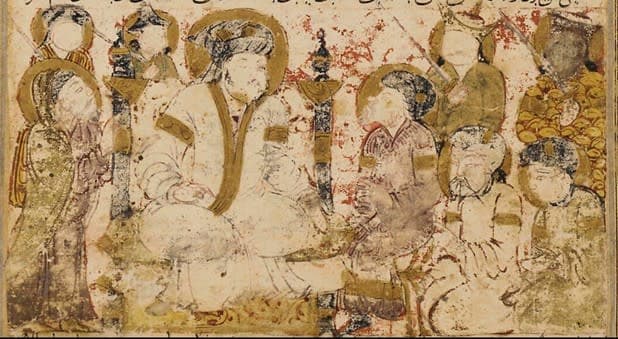

Abu al-ʿAbbas ʿAbdallāh was born in 722 under conditions of the deepest secrecy. His family, the Abbasids, belonged to the Hashimite clan and traced their lineage to al-ʿAbbās, the paternal uncle of the Prophet Muhammad. This kinship provided them with an immensely powerful ideological weapon the right to rule by blood relation to the Prophet which they skillfully wielded against the Umayyads, whom they accused of usurpation.

ʿAbdallāh’s youth was spent in Humayma, at the very heart of the Abbasid underground. While the last Umayyad caliph, Marwān II, was desperately trying to hold together a crumbling empire, the Abbasids were weaving networks of conspiracy. Marwān II, who had come to power on the points of his soldiers’ spears, found himself isolated: the Iranians disliked him, the old Arab elites despised him, and his brutality only multiplied the ranks of his enemies. In this atmosphere of total distrust, the Abbasids waited for their moment.

The fate of Abu al-ʿAbbas changed in October 749. After the arrest and death of his uncle Ibrāhīm in the dungeons of Harran, ʿAbdallāh suddenly, and unexpectedly even for himself, became the head of the family. Together with his brothers Abu Jaʿfar and Ibrāhīm he secretly moved to Kufa, a city that had always been a stronghold of opposition. For an entire month he lived incognito, hiding in the house of Abu Salama, until on 28 November 749, during the Friday prayer, he was proclaimed caliph.
His inaugural address entered history. Concluding it with a promise to increase the soldiers’ pay, he uttered the fateful words: “I am the one who pours forth (blood and bounty) openly, the avenger who annihilates.”
Thus his epithet—al-Saffāḥ was born. In Arabic, it carries a double meaning: “the shedder of the blood of enemies” and “the generous pourer of gifts.” This name perfectly captured his policy: mercilessness toward enemies and boundless generosity toward supporters.
Upon coming to power, al-Saffāḥ carried out an administrative revolution. Unlike the Umayyads, who trusted only their relatives, Abu al-ʿAbbas retained many of the old military commanders in their posts but placed his brothers and uncles above them. This made it possible to preserve control over the army without provoking an immediate revolt. Even the legendary Abu Muslim, the de facto architect of the Abbasid victory, was tactfully removed from supreme command and compensated with governance over the vast eastern provinces.
The greatest achievement of al-Saffāḥ was the transformation of the very nature of the Caliphate. The capital was moved from the “Syrian” Damascus to Kufa, and then to Anbar (al-Hāshimiyya). The Caliphate ceased to be a state of Arab aristocracy. From now on, the mawālī—Muslims of non-Arab origin, especially Persians—received equal rights. Abu al-ʿAbbas understood that his power rested on Iranian swords and did everything to ensure that they no longer felt like “second-class” Muslims. Thus an Arab state was transformed into a universal Islamic empire.
The reign of al-Saffāḥ was a time of “cleansing” the old world. His uncles, ʿAbdallāh and ʿAbd al-Raḥmān, methodically slaughtered the Syrian and Palestinian aristocracy that might have dreamed of restoring the Umayyads. The Syrian Arabs, once the main support of the throne, now became its principal enemies.
In the East, armies under the command of Ziyād ibn Ṣāliḥ brought Samarqand and Bukhara to submission. However, the most significant event was the Battle of Talas in 751. By defeating the combined Chinese–Turkic army, the Abbasids not only consolidated their influence in Central Asia but also achieved a technological breakthrough. Among the captives were Chinese craftsmen who revealed to the Arabs the secret of papermaking. This event predetermined the future flourishing of Islamic science and culture.


Abu al-ʿAbbas al-Saffāḥ was a master of political survival. Understanding that the people who had brought him to power could themselves become a threat to the dynasty, he began systematically eliminating them.
In 752, Abu Salama—the man in whose house the caliph had hidden before his accession—was killed. The murder was blamed on the Kharijites, but the strings were pulled by al-Saffāḥ himself. Then Sulaymān ibn Kathīr, one of the leaders of the underground movement, fell. Finally, the caliph pitted Abu Muslim against Ziyād ibn Ṣāliḥ, which led to the latter’s death.
These “internal purges” secured the Abbasids’ monopoly on power, though they left a bloody mark on the history of the dynasty’s formation.
The path of the first Abbasid was short. Just four years after his triumph, in 754, Abu al-ʿAbbas al-Saffāḥ died of smallpox in his residence in Anbar. He left to his brother, Abu Jaʿfar al-Manṣūr, the foundations of a state that would endure for another half millennium. Al-Saffāḥ accomplished the essential task: he transformed the chaos of civil war into a disciplined system of authority and permanently shifted the center of gravity of the Islamic world from West to East.


