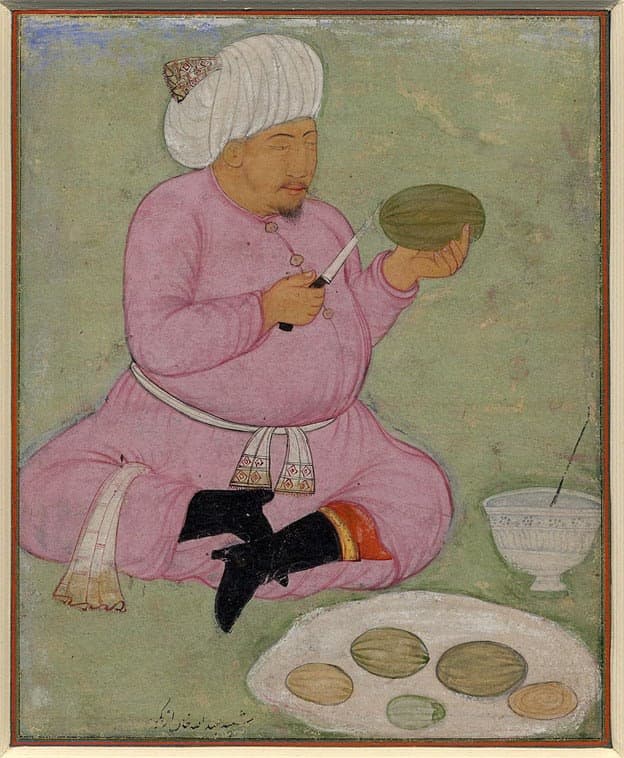

Abdullah was born in 1533 in the town of Afarinkent, to Iskandar, a member of a collateral line of the Shibanids.
After the death of Abdulaziz Khan in 1550, a struggle for the throne flared up. The Shibanid domains Bukhara, Samarkand, Tashkent, and Balkh contested supremacy. In 1551 Nawruz Ahmad Khan, who ruled in Tashkent, was proclaimed supreme khan. The young Abdullah, then governor of Kermine (Karmīna), launched a bid for power together with his uncle Pir-Muhammad Khan, the ruler of Balkh. After Nawruz Ahmad’s death in 1556, Pir-Muhammad Khan became the supreme ruler.

In 1557, relying on the support of Sufi shaykhs, Abdullah seized Bukhara and became its de facto ruler. In 1561 he proclaimed his father, Iskandar, supreme khan of all the Uzbeks. As Iskandar was more concerned with religious affairs, he handed the reins of government entirely to his son.
Abdullah set himself the goal of unifying the four Shibanid domains. He had to wage a long, determined struggle especially against Nawruz Ahmad’s sons, Baba Sultan and Darvish Beg. Though he suffered setbacks, he ultimately prevailed, and by 1582 he had restored a unified Shibanid state.
Abdullah Khan II carried out a sweeping monetary reform that stabilized the economy and ended the currency crisis. To offset the shortage of silver he instituted regular minting of gold coins and centralized the striking of silver at Bukhara; he also introduced copper coinage for everyday trade. The reform fostered transit, intercity, and local commerce.
Territorial expansion was another priority. In 1582 he recovered from Baba Sultan key Turkestan cities—Sauran, Yasi (Turkistan), Otrar, and Sayram. After his father’s death in 1583, Abdullah formally became khan and continued his conquests. He annexed Badakhshan in 1584, Khurasan in 1588, and Khwarazm in 1593–1594, greatly enlarging his realm.


Abdullah maintained close diplomatic ties with the great powers of his day the Mughals in India, the Ottoman Empire, and Russia. In 1575 the Ottoman sultan Murad III sent him muskets and artillery for the struggle against Shi‘i Iran.

Relations with Russia, however, were complicated, since Abdullah supported his kinsman, the Siberian khan Kuchum, in his war with the Russians. The Kazakh khans particularly Tauekel Khan also had fraught relations with Bukhara. In 1595 Tauekel sent his son to Moscow as a hostage in order to secure weapons to use against Abdullah and Kuchum.
Abdullah Khan was not only a talented commander and statesman but also a great patron of culture. He promoted trade and built monumental structures—madrasas, khanaqahs (Sufi lodges), caravanserais, market arcades, and bridges.


Under his rule Bukhara flourished. The city boasted more than 200 madrasas and numerous bazaars. Abdullah himself wrote poetry under the pen name ʿAwāz Ghāzī. He surrounded himself with scholars, men of letters, and historians. At his commission the historian Hafiz Tanish wrote the chronicle Abdullah-nama, and the poet Mushfiqi composed inscriptions for architectural monuments.
Abdullah also cared for the legacy of the past. By his order the portal of the mausoleum of Khwaja Ahmad Yasavi—begun in Timur’s time—was finally completed. He admired Timur and sought to emulate him, seeing him as the great sovereign of Turan.

Abdullah Khan II died on February 8, 1598. He was succeeded by his son ʿAbd al-Mu’min, whose reign was brief. Abdullah’s death triggered Khwarazm’s renewed independence and deepened political instability in the region.

Abdullah Khan was buried by the mausoleum of Bahaʾ al-Din Naqshband near Bukhara. His reign became a golden age for the Shibanid dynasty a time when statehood, the economy, and culture reached a high point. The historian Ahmad Donish counted him among the great “renewers of the century” (mujaddids) for his outstanding achievements.


