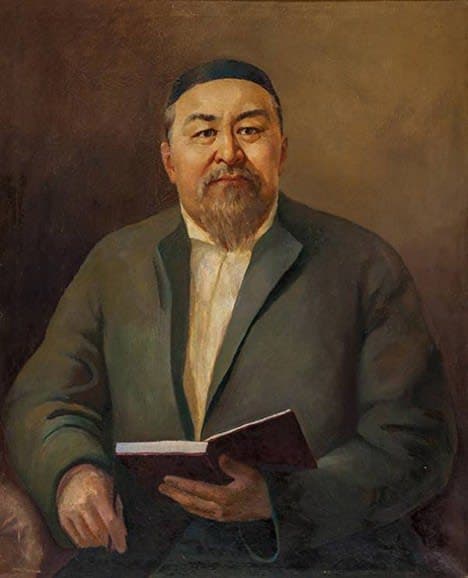
Abai Kunanbayev, whose given name was Ibrahim, was born on July 29 (August 10), 1845, in the picturesque locality of Zhidebai in the Chingiz Mountains. At that time, this area belonged to the Biysk Uyezd of the Tomsk Governorate; today it is the Abai District of the Abai Region of the Republic of Kazakhstan. He was the son of Kunanbai Oskenbayev (Uskenbayev), a wealthy and influential bai from the noble Tobyqty clan. Abai’s family was well known within their tribe; his grandfather Oskenbai and great-grandfather Irgizbai were respected rulers and biys (judges).
From an early age Abai began his education. He first studied at home with a mullah and then continued at the madrasa of Mullah Akhmet-Riza in Semipalatinsk. There he delved deeply into Arabic, Persian, and other Eastern languages. In parallel, he attended a Russian school, which later played a major role in shaping his worldview. Already in his youth, by the end of his studies, Abai began to try his hand at poetry, though out of modesty he attributed his first verses to his friend Kokpai Zhantasov.
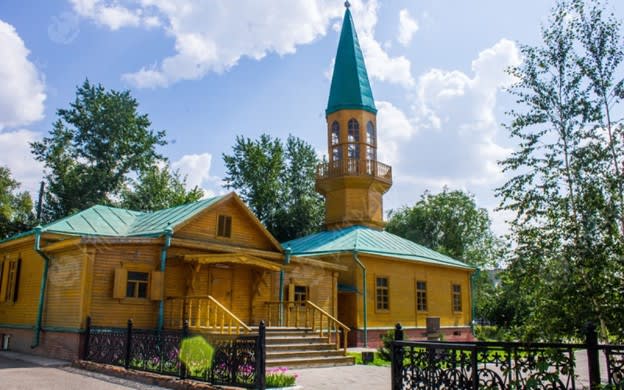
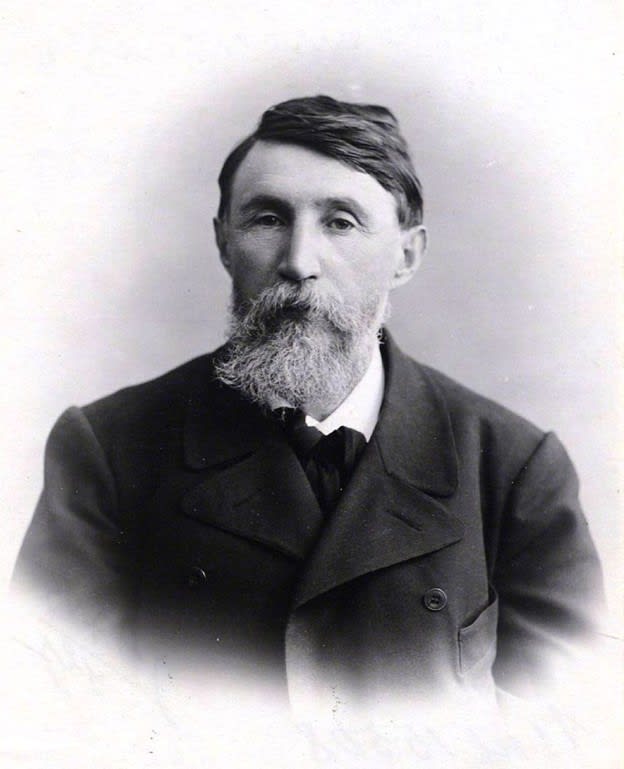
From the age of thirteen, his father Kunanbai actively involved Abai in governing the clan, preparing him for leadership. By the age of twenty-eight, however, Abai had lost interest in this activity and withdrew from it in order to devote himself entirely to self-education. This period became a turning point in his life, but only by the age of forty did his creative work attain maturity; it was then that he wrote his first “adult” poems.
Abai was strongly influenced by his interactions with Russian political exiles such as Yevgeny Mikhaelis, Nifont Dolgopolov, and Severin Gross. Through them he became acquainted with the riches of Russian and European culture. The formation of his humanistic worldview also took place under the influence of great Eastern poets and scholars such as Ferdowsi, Alisher Navoi, Nizami, Fuzuli, and Ibn Sina (Avicenna).

Abai became a true bridge between cultures. He translated works by the Russian classics Krylov, Lermontov, and Pushkin, and he also introduced the Kazakh people to European literature by translating Goethe and Byron. A vivid example of such cultural exchange is his poem “Qarañğı tünde tau qalğyp” (“The mountains doze in the dark night”). This poem became a folk song and has an intriguing history: it is a translation of Lermontov’s “The mountain peaks sleep in the nocturnal dark,” which in turn was an adaptation of Goethe’s “Wanderer’s Night Song.”

Although Abai for a time held the position of volost (rural district) administrator, this experience, as seen from his 1889 poem “Studying to no purpose, I have let life slip by…,” brought him disappointment. In that work he reflected on the futility of his post, on how “impudent ignoramuses” led him astray, and on his weariness.
Soviet literary scholars often emphasized the innovative character of his work. They noted that Abai ridiculed backward customs and spoke out against the “enslaved status of women,” social evil, and ignorance views reflected in such poems as “At last I became a volost chief…” (1889), “The administrator rejoices in his superiors…” (1889), and “Kulembay” (1888).
He was a genuine innovator of Kazakh poetry. His poems dedicated to the seasons — “Spring” (1890), “Summer” (1886), “Autumn” (1889), and “Winter” (1888) as well as works on the mission of poetry imbued with the idea of enlightenment, became a new word in Kazakh literature. In his narrative poems such as “Masgud” (1887) and “The Tale of Azim,” he drew on motifs of classical Eastern literature. In the poem “Iskander” he boldly opposed reason, personified by Aristotle, to greed, embodied in the figure of Alexander the Great, demonstrating his profound philosophical outlook.

Abai also introduced new forms into Kazakh versification, such as octaves and six-line stanzas, along with new meters and rhyme schemes. In total he created about 170 lyric poems, 56 translations, and several narrative poems.
Abai was not only a poet but also a talented composer. He created around two dozen melodies that harmoniously combined Kazakh and Russian motifs. He did not write his songs down, yet they became so popular that they were preserved and recorded after the revolution by figures such as A. E. Bimboes, A. V. Zataevich, L. A. Khamidi, A. K. Zhubanov, and B. G. Yerzakovich. His most famous song, “Közimniñ qarasy” (“You are the pupil of my eye”), became truly folkloric.
In his later years Abai wrote his most famous prose work Qara söz (“The Simple Word”), known as the Words of Edification. This collection, consisting of forty-five parables and philosophical essays, addressed important questions of the history, pedagogy, morality, and law of the Kazakh people. The Words of Edification have been translated into many languages, including English, French, Chinese, Korean, Turkish, Uzbek, and others, attesting to their universal significance and value.
Abai Kunanbayev died on June 23, 1904, in Zhidebai; later a mausoleum was built at his burial site in his honor.


Abai Kunanbayev exerted an enormous influence on the formation of the Kazakh national intelligentsia of the late nineteenth and early twentieth centuries. The leaders of the Alash-Orda movement saw in him their spiritual precursor and a leader of national revival. It was Alikhan Bukeikhanov who became Abai’s first biographer, publishing an obituary in the newspaper Semipalatinsky Listok in 1905 and later in the journal Notes of the Semipalatinsk Subsection of the West Siberian Department of the Imperial Russian Geographical Society in 1907.
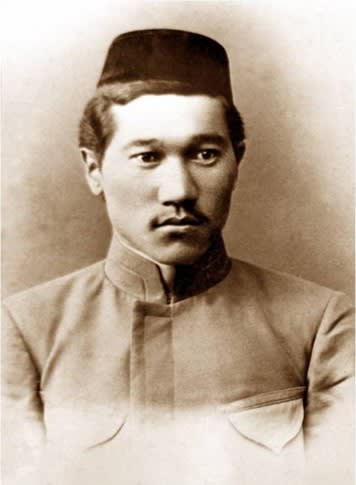
In 1914 the Turkologist V. V. Gordlevsky included the works of Abai and Mirzhakyp Dulatov in the Oriental Miscellany published in honor of the seventieth birthday of the Orientalist N. I. Veselovsky, thereby securing for Abai the status of one of the most prominent figures of Kazakh literature.
The legacy of Abai Kunanbayev remains to this day an inexhaustible source of wisdom and inspiration. He was not merely a poet, but a philosopher, educator, and composer who forever changed Kazakh culture and laid the foundation for its further development.


